The Same Stranger, Again: Identical Figures Reported Across Unconnected Waiting Rooms, Years and States Apart
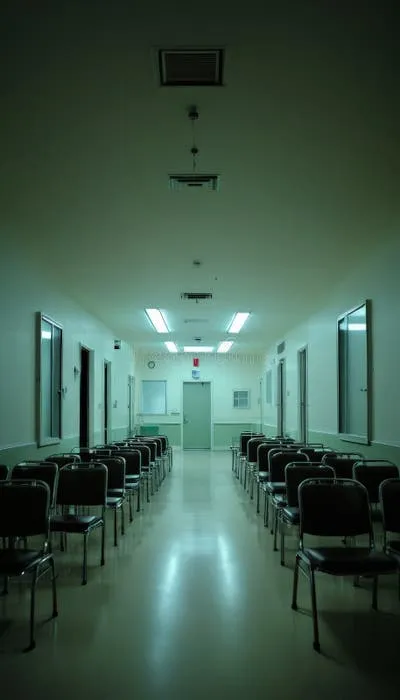
Photo: empty waiting room plastic chairs fluorescent lighting institutional lobby, via thumbs.dreamstime.com
They Were Already There
The first thing every witness says, without exception, is that the individual was already seated when they arrived. Not that they saw the person sit down. Not that they arrived together or after. Already there. Present before the witness entered, present in a way that suggested they had always been present, that the room had been arranged around them rather than the other way around.
This detail — small, seemingly incidental — is the thread that connects seven facilities across five states and approximately nine years of documented reports. Seven locations with no administrative relationship, no shared corporate parent, no common architectural firm, no overlapping staff. A county health clinic in rural Tennessee. A Department of Motor Vehicles branch office in suburban Ohio. Two separate airport terminal waiting areas, one in Dallas and one in Minneapolis. A corporate HR lobby in Atlanta. A community college financial aid office in Fresno, California. A walk-in urgent care facility in suburban New Jersey. In each of these spaces, across a span of time that makes coincidence functionally impossible, multiple unrelated witnesses have described the same individuals.
The Composite Description
Assembling a composite from independent witness accounts is methodologically imprecise. Memory is reconstructive. Descriptions drift. People confabulate details they believe they should have noticed. All of these caveats apply, and none of them adequately explain the degree of convergence in the accounts collected here.
The figures — there appear to be at least three distinct individuals, though witness accounts suggest possible overlap — are consistently described as middle-aged, presenting as neither particularly young nor elderly, dressed in clothing that witnesses variously describe as "normal" or "office-appropriate" but that on reflection strikes them as slightly out of period. Not costumed. Not conspicuous. Simply wearing the clothes of someone who left for work approximately fifteen years ago and has not yet arrived. One witness, a graphic designer in her early thirties who encountered the figure in the Atlanta corporate lobby, described the clothing as "the kind of thing you'd find in a stock photo from 2009 — technically fine, but wrong in a way you can't immediately name."
The posture is the second consistent element. Seated, upright, hands in lap or resting on the armrests of waiting room chairs. Not reading. Not on a phone. Not interacting with the environment in any way that suggests they are waiting for something in the way that people in waiting rooms wait — with the visible restlessness of someone who knows time is passing. They are still in a way that is not relaxed. Several witnesses have used the word "patient" to describe this quality, and then immediately noted that the word felt wrong, that patience implies an expectation of resolution, and that these figures did not appear to expect anything.
The Eye Contact Problem
Every witness, across every facility, notes the same thing: the figures do not make eye contact. This is not the avoidance of someone who is shy or preoccupied. It is more systematic than that. Witnesses who deliberately positioned themselves in the figure's line of sight report that the figure's gaze seemed to adjust — not dramatically, not with any visible movement of the head, but subtly, incrementally, maintaining a consistent angle of non-engagement regardless of where the witness moved. One witness, a retired schoolteacher who encountered such a figure in the Ohio DMV branch, spent approximately twenty minutes attempting to catch the figure's eye before her number was called. "It wasn't that they were looking away," she said in her account. "It was that looking at me wasn't something they were able to do. Like I was in a direction they didn't have."
The DMV account is one of three in which a witness attempted to initiate verbal contact. All three report the same outcome: the figure did not respond, did not turn, did not acknowledge the attempt in any way. In one case, a witness reports that a staff member behind the service counter — when asked about the seated individual — looked toward the figure's chair and then back at the witness with an expression described as "professionally neutral in a way that felt practiced, like they'd answered that question before without using any words."
Threshold Architecture and the Figures That Occupy It
The seven facilities share no obvious connection, but they share a category. Each is a threshold space — a location defined by its transitional function, a place where people wait to become something slightly different than what they were when they entered. You enter a DMV as a civilian and leave as a licensed driver. You enter a clinic as a patient and leave as a diagnosed or cleared one. You enter an airport terminal as a local and leave as a traveler. These spaces exist between states of being, and they share an architectural vocabulary — the molded plastic chairs, the numbered tickets, the service windows, the fluorescent light — that signals this in-between quality to anyone who occupies them.
Backrooms researchers have long noted that threshold architecture appears disproportionately in no-clip event reports. The geometry of transitional spaces — the way they are designed to be passed through rather than inhabited, the way they accumulate a kind of ambient human presence without retaining individual identity — may create conditions that the Backrooms finds navigable, or exploitable, or simply familiar.
The figures, in this framework, may not be visitors to these spaces. They may be features of them. Residue of the thousands of people who have waited in identical chairs under identical lights for things that were or were not resolved. Echoes of occupancy that the space has absorbed and cannot quite release.
What They Are Waiting For
No witness has ever seen one of these figures called. No witness has seen one stand, approach a service window, or leave the waiting area under their own volition. In three accounts, witnesses report that when they looked away and then back, the figure was no longer present. In one account, from the Fresno financial aid office, a witness reports that the chair the figure had occupied was warm when she sat in it afterward — "not body-warm," she specified in her written account, "but warm the way a room gets warm when it has been occupied for a very long time by something that generates a small amount of heat."
They are waiting. Whatever they are waiting for, it has not happened yet. Whatever they are, they were already there when you arrived, and if you return to the same room in a different city in a different year, there is a reasonable probability that they will be there again.
Already seated. Already still. Already not looking at you in a direction they don't seem to have.