Nobody Clocked In: On the Corporate Breakrooms Found in Buildings That Never Had Employees
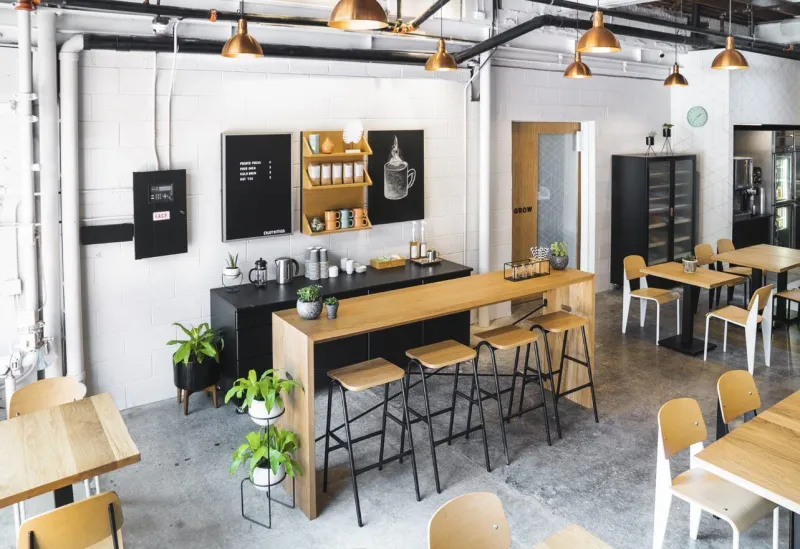
Photo: empty corporate office breakroom fluorescent light coffee maker, via i.pinimg.com
There is a grammar to the American corporate breakroom that is so consistent, so thoroughly standardized, that it functions less like a designed space and more like a genre. You know the room before you enter it. You know the smell — burnt coffee and the ghost of someone's reheated lunch — and you know the light, which is fluorescent and merciless and hums at a frequency just below the threshold of conscious annoyance. You know the round table with four chairs, one of which wobbles. You know the bulletin board with its overlapping layers of notices, the bottom ones so old they have gone translucent at the edges.
The grammar of the breakroom is a grammar of collective routine. It is a space that accumulates evidence of the people who use it: the birthday listed on the dry-erase calendar in someone's looping handwriting, the passive-aggressive note above the sink about dishes, the photograph from the company picnic held to the refrigerator by a magnet shaped like the state of Ohio. Remove the people and the space becomes something else. It becomes a record — and a record that, in the cases documented here, points toward a workforce that cannot be traced.
What Was Found
This publication has gathered accounts of nine distinct breakroom discoveries in buildings across the United States over the past several years. The buildings vary: a former light-manufacturing facility in western Pennsylvania converted to mixed-use retail, a three-story office park in suburban Phoenix that has been vacant since the mid-2010s, a floor of a Chicago building whose corporate tenant relocated and whose space was never re-leased. In each case, a room was found — sometimes behind an unlocked door, sometimes behind one that had been locked and was found to open anyway — that was furnished and branded as a functioning corporate breakroom.
The branding is the detail that unifies these accounts and that this publication finds most difficult to explain. Each breakroom bears the logo and visual identity of a company — a name, a color palette, a tagline — that does not appear in any corporate registry this publication has been able to consult. The Secretary of State databases for the relevant states contain no record of the companies as legal entities. The US Patent and Trademark Office contains no record of the logos as registered marks. The companies, as far as any official record is concerned, do not exist and have never existed.
And yet their breakrooms are meticulous. The refrigerators are plugged in and running. The coffee makers — a brand of commercial drip machine that is itself real and purchasable — contain grounds in the basket and, in three of the nine accounts, water in the reservoir that witnesses describe as still warm. The vending machines, where present, are stocked. The birthday calendars on the wall are filled in for the current month.
The Personal Items
It is the personal items that make these spaces genuinely unsettling, in a way that the branding alone does not.
A breakroom is a public-private space. It is corporate territory that workers colonize with small private gestures — a coffee mug with a name on it, a photograph, a book left on the table, a crossword puzzle started and abandoned. These gestures are evidence of habitual presence, of people who return to a space often enough to feel entitled to leave something of themselves in it.
In six of the nine documented breakrooms, personal items of this kind were present.
In a Phoenix facility, a ceramic mug reading World's Okayest Manager sat on the counter beside the coffee maker, rinsed clean. In a Pennsylvania breakroom, a spiral notebook on the table contained what appeared to be meeting notes in three different hands, the most recent entry dated to a Tuesday — though the year listed was formatted in a way that the witness who found it described as not quite right, in a way she could not specify further. In Chicago, a child's drawing was held to the refrigerator by a magnet: a house, a sun, two figures of unequal height. Below the drawing, in the child's handwriting: For Dad at work.
None of the witnesses removed these items. Several report that they wanted to but found themselves unwilling to touch them, for reasons they could not articulate at the time.
The Motivational Poster Problem
Every breakroom in every documented case contained at least one motivational poster. This is unremarkable on its face — motivational posters are to the American corporate interior what icons are to a Byzantine church, ubiquitous and load-bearing in ways that are more psychological than structural.
What is remarkable is that the posters in these spaces are not quite right.
The format is correct: a high-contrast photograph, a single word in large type, a brief subordinate clause below. The photography is professional. The typography is clean. But the words are wrong — not offensive or alarming, simply slightly off, in the way that a word looks wrong when you stare at it too long. One poster, photographed by a witness in the Pennsylvania facility, reads CONTINUITY above an image of a long hallway receding into a vanishing point. The subordinate clause reads: The work continues because the work has always continued.
Another, from the Chicago location, reads PRESENCE above an image of an empty conference room, chairs pushed in, blinds half-open. The subordinate clause: Someone is always here.
This publication does not read these as threatening in any conventional sense. They read as the product of a corporate communications department that understood the form of motivational language without quite understanding its function — or that understood a different function entirely.
What the Breakroom Is For
The American corporate breakroom exists to give workers a place to be off the clock while remaining on the premises. It is a liminal space by design — neither fully work nor fully rest, a room where the company's authority is suspended just enough to allow the impression of relief. It is, in this sense, a room built around the concept of a pause.
The breakrooms documented here appear to have been built around the same concept, with the pause made permanent. The coffee is always almost fresh. The calendar is always current. The birthday of someone named J. Harwick or M. Peluso or simply Marcus is always this week or next. The room is always ready for people who are about to arrive.
In none of the nine documented cases have those people arrived during the time a witness was present.
In none of the nine cases has a witness been willing to stay long enough to determine whether they eventually would.