The Route That Remembers Itself: Mail Carriers and the Streets That Rearrange
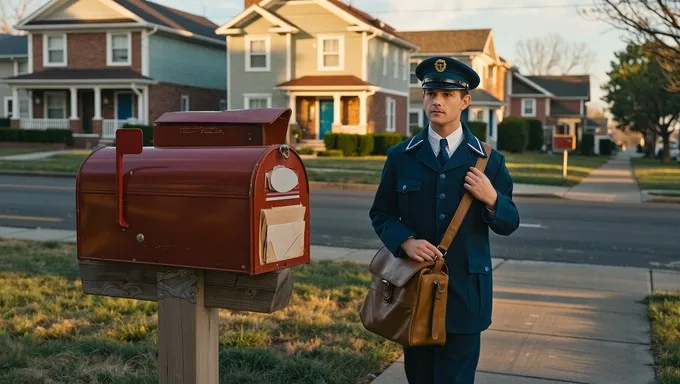
Photo: mail carrier walking suburban street residential neighborhood overcast, via images.stockcake.com
There is a specific kind of knowledge that belongs only to people who walk the same ground every day.
Not the knowledge of maps, which are fixed and therefore already wrong by the time they are printed. Not the knowledge of drivers, who move too fast for the street to register as anything more than a surface. The knowledge of mail carriers is something else — accumulated, embodied, written in muscle and repetition. After enough years on a route, a letter carrier does not think about where they are going. The body knows. The feet know the distance between mailboxes. The hands know the weight distribution of Tuesday versus Thursday. The route becomes a kind of second nervous system, running parallel to the one you were born with.
Which is why, when the route begins to change, the carrier knows before they can articulate why.
The Doubling
The most commonly reported anomaly — documented in carrier forums, in informal conversations with supervisors, and in at least two formal incident reports that were subsequently filed without response — is what carriers refer to among themselves as "the doubling."
It presents simply. A carrier completes a delivery to a house at, say, 1147 Elm. They continue down the block, work through the next several addresses, and arrive at a house that is — by every visible indicator — 1147 Elm again. Same paint. Same porch configuration. Same mailbox, including the small dent on the left side that the carrier noticed two years ago and has noted ever since as a landmark. The number on the box reads 1147.
The mail for 1147, which the carrier has already delivered, is no longer in their bag.
This is the detail that distinguishes the doubling from a simple memory lapse or a moment of distraction. The mail is gone. It was delivered. And yet the house is here again, waiting.
Marcus Thibodeau, a carrier with seventeen years on a suburban Maryland route, described his first encounter with the doubling in terms that were measured and frustrated in equal parts. "I'm not someone who misremembers things," he said. "I've walked that route eight thousand times. I know every house. I delivered to 1147, I moved on, and then 1147 was in front of me again. I stood there for a minute. I kept walking. I didn't put anything in the box because I didn't have anything left to put in it. I don't know what that means."
He paused. "I've never told my supervisor. There's no form for it."
New Addresses
The doubling is unsettling. What carriers describe as "the additions" is something worse.
An addition is an address that was not on the route yesterday and is on the route today. Not a new construction — there is no scaffolding, no fresh concrete, no lumber smell. The house simply appears to have always been there, wedged between two addresses the carrier knows well, bearing a number that fits sequentially into the existing pattern as though it were always part of it. There is often mail for this address already in the carrier's bag, sorted at the distribution center that morning, as though the address exists in the postal system's records without anyone having noticed when it was entered.
Lorraine Speck, twenty-two years on a route in south-central Pennsylvania, described finding an addition for the first time with a precision that suggested she had rehearsed the description many times before deciding to share it. "It was a gray house," she said. "Two stories. A front porch with a swing. Completely ordinary. The address was 334, which fits between 332 and 336, which I've delivered to for twenty years. There was a piece of mail for it — a utility bill, standard envelope. I put it in the box. The next day, 334 wasn't there. The mail I'd delivered wasn't returned. 332 and 336 were right next to each other, like always. I checked the route sheet. 334 was not on it. It had never been on it."
She delivered to 334 four more times over the following two years. Each time, the house appeared without announcement. Each time, there was a piece of mail for it. Each time, she delivered the mail. She has never seen anyone enter or leave the house. She has never seen the porch swing move.
"I think about the utility bill," she said quietly. "Someone is running something in that house. Something is using power."
The Postal Service's Silence
Requests for comment submitted to the United States Postal Service regarding anomalous route reports were not answered. A FOIA request for incident documentation related to carrier-reported geographic irregularities returned a response indicating that no responsive records existed.
This is not surprising. The USPS is an institution built on the premise that every address is findable, every route is walkable, every piece of mail is deliverable. The entire organizational logic depends on geography being stable. To acknowledge that routes are occasionally something other than stable would require an infrastructure of response that does not exist and, perhaps, a vocabulary that has not been developed.
Carriers, for their part, have developed their own vocabulary. They call unstable sections of route "soft spots." They describe the feeling of approaching a soft spot as a particular kind of attention — a sharpening, a wariness, a sense that the street is about to ask something of them that the street has no right to ask.
Marcus Thibodeau described finishing his route on days when the doubling occurred as arriving home with a feeling he struggled to name. "Not scared," he said finally. "More like — I've been somewhere I wasn't supposed to be, and the somewhere let me leave. That day. It let me leave that day."
He still walks the route. He has not requested a transfer. When asked why, he thought about it for a long time.
"Because I know it," he said. "Because the route knows me. And I think, if you have to be somewhere like that, it's better to be known."