Registered to Nowhere: The Anomalous Vehicle Records, Ghost Addresses, and Impossible Title Transfers Accumulating in State DMV Databases
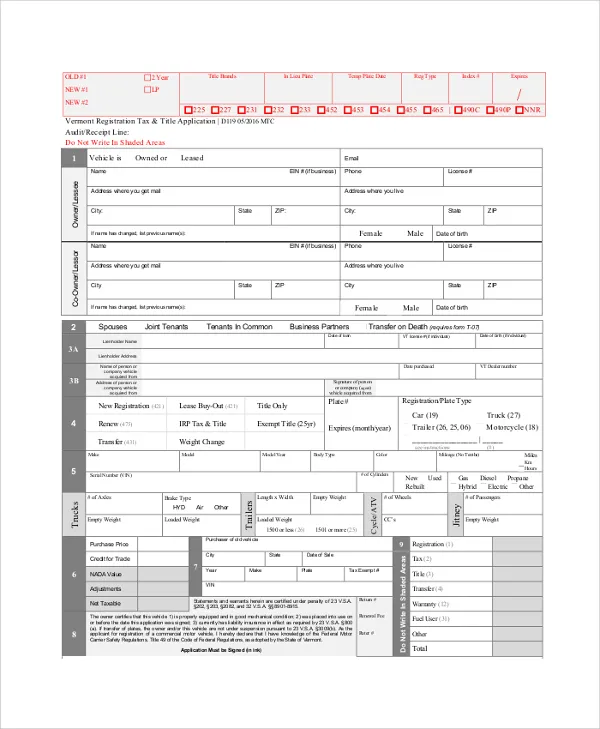
Photo: DMV registration documents bureaucratic paperwork official forms, via images.sampletemplates.com
Across at least eleven state motor vehicle databases, a pattern of anomalous registration records has been quietly accumulating for decades — vehicles assigned to street addresses that satellite imagery confirms have never held a structure, license plates photographed by traffic enforcement systems on roads that do not connect, and at least one notarized title transfer bearing a commission number that does not appear in any state registry. The administrative apparatus of the American state has been receiving this paperwork and filing it without apparent alarm. This record examines what that filing practice implies.
The Bureaucratic Threshold
The Department of Motor Vehicles is, by institutional design, incurious. It processes. It files. It issues. It does not, as a general operational matter, ask whether the address on a registration form corresponds to a structure that physically exists, because the volume of transactions it handles daily — hundreds of thousands across the larger states — makes individual verification functionally impossible. This is not a criticism. It is an observation about the kind of system that would be most useful to an entity, or a process, or a spatial phenomenon that needs to generate paperwork.
This archive does not speculate about intent. It catalogs what the records show.
Category One: The Phantom Addresses
The most straightforwardly documentable anomaly class involves vehicle registrations assigned to addresses that do not correspond to any structure in the relevant municipality's property records, tax rolls, or satellite imagery archive.
A representative example: a 2003 Chevrolet Silverado registered in a rural county in central Ohio to a street address on a road that county GIS data confirms terminates in an agricultural field approximately 0.4 miles before the address number would logically fall. The registration has been renewed continuously since 2003. The vehicle has passed biennial emissions testing in each applicable year, which requires physical presentation of the vehicle at a licensed testing facility. The testing records exist. The address does not.
This archive has cataloged forty-seven similar cases across Ohio, Michigan, Indiana, Kansas, and Oregon. In each case, the registration is current, the renewal history is unbroken, and the address is demonstrably fictitious — not fraudulently fictitious in the conventional sense of a PO box or a neighbor's address, but fictitious in the sense that the physical location described has never, at any point in the available satellite record, contained a structure of any kind.
Several of these registrations list the vehicle's primary use as "commute." This detail is noted without further comment.
Category Two: The Traffic Camera Anomalies
The second anomaly class is geometrically more troubling. It involves license plates captured by automated traffic enforcement systems — red-light cameras, speed enforcement cameras, toll plaza imaging systems — at locations that road network data indicates are not accessible from one another within the timeframes the timestamps record.
A plate registered in suburban Minneapolis was photographed by a toll system camera on a highway in central Iowa at 2:14 p.m. on a Tuesday in October 2019. The same plate was photographed by a red-light camera in the Minneapolis metro area at 2:31 p.m. on the same date. The distance between the two locations is approximately 290 miles. The elapsed time between the two photographs is seventeen minutes.
This is not the only such case. This archive has identified nine instances of the same structural pattern across six states, with elapsed times ranging from eleven minutes to twenty-three minutes and distances ranging from 180 miles to over 400. In each case, both photographs are genuine — confirmed by the relevant agencies through records requests — and in each case the vehicle in question is registered to an address in the phantom category described above.
The working hypothesis this archive does not endorse but cannot entirely dismiss is that these vehicles are, at least intermittently, not traveling on roads that appear in any public map database.
Category Three: The Notary
In 2021, a title transfer for a 1997 Honda Accord was processed by the Oregon DMV. The transfer was notarized. The notary's name, commission number, and county of commission appeared on the document in the correct format and with no surface irregularities. The commission number, when cross-referenced against the Oregon Secretary of State's notary public database — a public record — does not exist. The name associated with the number does not appear in any year of the Oregon notary registry.
The title transfer was accepted and processed. The Accord is currently registered in good standing to a street address in Portland that, per Multnomah County property records, is a vacant lot with no history of permitted construction.
This archive submitted a records request to the Oregon DMV regarding this specific transaction. The response, received after a standard processing delay, confirmed the existence of the record and noted that it had been processed in accordance with standard procedure. When asked to clarify how a commission number not present in the state registry had been accepted as valid, the agency's response stated that the document had met all required formatting standards at the time of submission.
Formatting standards. Not verification standards. Formatting standards.
What the Filing Implies
The American administrative state processes millions of documents annually. It is built, by operational necessity, on the assumption that the documents it receives describe things that exist — addresses that hold structures, notaries that hold commissions, roads that connect the places they are said to connect. It is not built to ask whether the paperwork it receives was generated somewhere outside the world it administers.
This archive does not claim to know how long the Backrooms has been producing paperwork. The oldest anomalous registration identified in this survey dates to 1987. Whether earlier records exist in paper archives not yet digitized is a question that would require a different kind of research than this record represents.
What this record can say with confidence is the following: the paperwork has been arriving. The paperwork has been filed. The renewal fees, in the cases this archive has been able to confirm, have been paid — on time, every time, by methods that the receiving agencies have accepted without irregularity.
Something has been maintaining these registrations.
Something has been keeping its documents current.
This archive recommends that readers who encounter a vehicle with a registration sticker that is precisely, impeccably up to date — and who find themselves unable to identify the driver — exercise whatever judgment seems appropriate to the situation. We are not in a position to advise further than that.