The Last Watch: A Story of the Lifeguard Who Stayed at Her Post When the Shore Stopped Making Sense
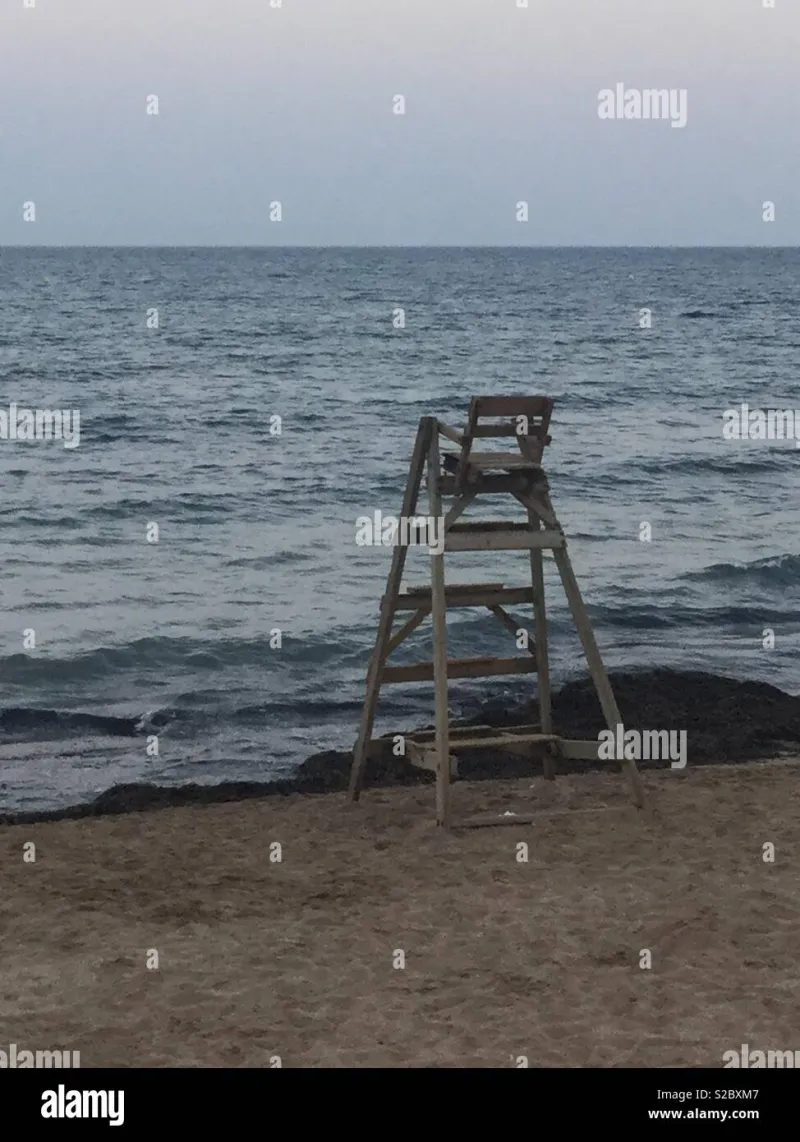
Photo: empty lifeguard chair Lake Michigan beach overcast sunset, via c8.alamy.com
On a late August evening at a Lake Michigan beach, a seasonal lifeguard named Dara Voss noticed that the swimmers had stopped casting shadows on the sand. What followed over the next forty-seven minutes — or what she estimates was forty-seven minutes — constitutes one of the most geometrically coherent displacement accounts ever submitted to this archive. The woman who drove home that evening knew where she lived. Whether she was the same person who had climbed into the chair that morning is a question this record cannot answer.
 Photo: Dara Voss, via upload.wikimedia.org
Dara was twenty-three, finishing her third summer at a public beach in a mid-sized lakeside town in Michigan's Lower Peninsula. She had done closing shift a dozen times before. The routine was fixed: wait for the last swimmers to leave, blow three whistles, walk the waterline once, padlock the bathhouse, drive home. She knew the beach the way you know a room you have slept in for years — by feel, by the particular sound the sand made under her sandals, by the way the late-day light came off the water at a low and copper angle.
 Photo: Michigan's Lower Peninsula, via img.jagranjosh.com
She does not remember the exact moment things changed. That is consistent with nearly every account in this archive. The threshold does not announce itself.
What she remembers is sitting in the elevated chair and becoming aware, without quite knowing when the awareness had started, that the light on the water was wrong. Not wrong the way weather is wrong — overcast, or hazy, or unexpectedly bright. Wrong the way a photograph is wrong when someone has replaced the sky in post-production and not quite matched the color temperature. The water below her was reflecting a sky that was approximately fifteen degrees cooler in tone than the one above her head. She looked up. She looked down. She did this several times. The discrepancy did not resolve.
Then she noticed the shadows.
There were still swimmers in the water — or figures that moved the way swimmers move, arms breaking the surface in slow arcs, heads turning to breathe. But none of them cast shadows on the sand at the waterline. The sun was still present, still low and specific and directional. Her own shadow stretched behind her in a long thin line. The lifeguard stand cast a shadow. The trash barrel near the bathhouse entrance cast a shadow. The swimmers cast nothing. Their absence on the ground was the kind of absence that, once seen, could not be unseen.
She blew three whistles. Standard closing protocol.
The figures in the water did not respond. They continued their slow, patient arcs.
She climbed down from the chair. This is where her account becomes spatially difficult to follow, and where it aligns most precisely with documented Level 0 geometry. She began walking toward the bathhouse to retrieve the padlock. The bathhouse was, by her estimate, perhaps eighty feet behind the chair — a low concrete structure, painted the particular municipal green that public facilities in this part of the country have favored since the 1970s. She walked toward it. She counted her steps. At twenty paces she looked up and the building was no closer. At forty paces it appeared, if anything, slightly farther. The sand beneath her feet was soft and warm and entirely normal. She was not walking in place. She was covering ground. The bathhouse was simply not receiving her.
She stopped. She turned around.
The lake was closer than it should have been.
Not dramatically closer — not the sudden lurch of a horror film. Just wrong by a margin that should not have been possible. The waterline, which had been perhaps thirty feet from the base of the chair, was now perhaps fifteen. And something at the waterline was moving. Not swimming. Not walking. Moving in the way that a thing moves when it has not yet decided what shape it intends to be — a low, lateral motion, jointed in too many places, pausing between movements the way an insect pauses between steps, testing the surface before committing weight.
She did not run. She reports this herself, with something that reads in the transcript as embarrassment. She did not run because her training told her not to run near water. Twenty-three years old, three summers of certification, and the muscle memory of a thousand safety briefings held her feet in place while something with too many joints moved toward her up the wet sand.
What she did instead was blow her whistle again.
The sound that came back to her was not an echo. It was a whistle — the same pitch, the same duration — blown by something that was not her, from a direction she could not locate. Somewhere between the water and the sky. Somewhere inside the wrong reflection.
Her next clear memory is sitting in her car in the beach parking lot. The lot was empty. The sun had fully set. Her keys were in the ignition and the engine was running, which means she had started it, though she does not remember doing so. The padlock was in her lap, locked, which means she had reached the bathhouse at some point, though she does not remember that either.
She drove home. She ate dinner. She slept.
She returned the following morning for her next scheduled shift and the beach was exactly as it had always been — the bathhouse at its correct distance, the water casting the correct reflection, the early swimmers trailing shadows behind them on the sand like ordinary people.
The account was submitted to this archive eight months after the incident. In the cover note, Dara writes that she has not been able to look directly at her own reflection since August. Not because it shows her something wrong. Because it shows her something entirely correct — and she is no longer certain that correctness is the reassurance it used to be.