Phantom Properties: When Legal Documents Create Spaces That Don't Exist
Photo: empty office building legal documents real estate contracts, via golexproperties.com
The Pattern Emerges
It began with isolated incidents that seemed like clerical errors. A property deed in Portland, Oregon, for a three-bedroom apartment at an address that led to a parking meter. A commercial lease in Atlanta, Georgia, for retail space inside what appeared to be the solid concrete wall of an office building. Real estate attorneys dismissed these as database mistakes, surveying errors, or simple human incompetence in an industry built on precise documentation.
 Photo: Portland, Oregon, via oregonessential.com
But the incidents accumulated. By 2019, the American Bar Association's Real Property Section had received enough reports to warrant an informal investigation. What they discovered defied conventional understanding of how property law, municipal records, and physical reality intersect.
The Documentation Problem
Sarah Chen, a real estate attorney in Sacramento, California, first encountered the phenomenon while reviewing a residential lease agreement that had been flagged by her firm's title insurance company. The property address—1247 Elm Street, Unit 4B—appeared valid in all municipal databases. The building permit history showed a four-story apartment complex constructed in 1987. Property tax records indicated regular payments. Utility connections were active and current.
 Photo: Sacramento, California, via farm8.staticflickr.com
The problem was that 1247 Elm Street was a single-story dry cleaner that had operated at the same location since 1962. The building had never been more than one story tall. No apartment complex existed at that address, had ever existed at that address, or could exist at that address given the lot dimensions and zoning restrictions.
"I drove out there personally," Chen recalls. "I stood on the sidewalk with the lease agreement in my hand, looking at this tiny dry cleaning shop, and the paperwork insisted there was a four-story building with twelve residential units. The tenant I was representing claimed to have toured Unit 4B the previous week. She described hardwood floors, a galley kitchen, and a view of the park from the bedroom window. There is no park visible from that location."
Chen's client, marketing coordinator Jennifer Walsh, maintained that she had not only toured the apartment but had left a security deposit with the landlord. She produced a receipt, properly notarized, for $1,200. The receipt listed the address as 1247 Elm Street, Unit 4B. The landlord's signature matched records on file with the county clerk's office for the property owner.
The property owner, when contacted, had no knowledge of any residential units, any lease agreements, or any tenant named Jennifer Walsh. He had owned the dry cleaning business for thirty-five years and lived in the apartment above the shop—a space that, according to building records, did not exist.
Geographic Impossibilities
The Sacramento case was not isolated. Real estate professionals across the country began reporting similar incidents with increasing frequency. In Minneapolis, Minnesota, a commercial lease was executed for warehouse space at an address that, upon investigation, was located in the middle of the Mississippi River. The lease specified 50,000 square feet of climate-controlled storage, loading dock access, and proximity to major freight corridors. The lessee, a logistics company expanding their regional operations, claimed to have conducted a thorough inspection of the facility.
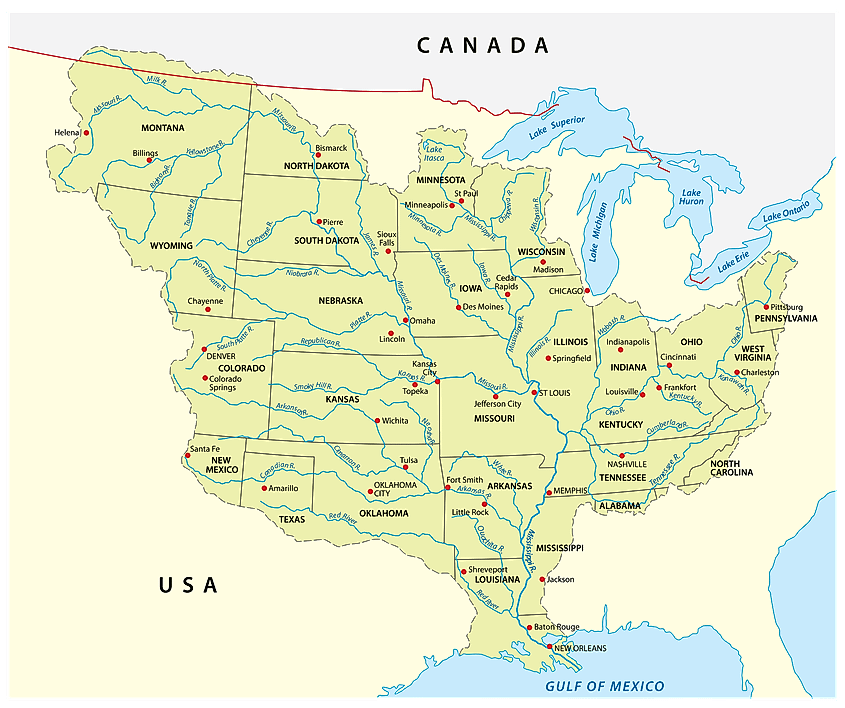 Photo: Mississippi River, via www.worldatlas.com
Denver attorney Michael Rodriguez encountered a property deed for a single-family home whose address placed it 200 feet underground, beneath the foundation of an existing office building. "The surveyor's report was comprehensive," Rodriguez explains. "Soil composition, drainage, foundation requirements, everything you'd expect. The GPS coordinates were precise. But those coordinates put the property directly below a Starbucks in the financial district."
The buyer in Rodriguez's case had secured a mortgage, passed inspection, and received title insurance. The mortgage company's appraisal valued the property at $485,000, citing comparable sales in the neighborhood and the home's "unique architectural features." When Rodriguez requested clarification on those features, the appraiser mentioned "innovative use of vertical space" and "creative approaches to natural lighting."
The Tenant Experience
Perhaps most disturbing are the accounts from tenants and buyers who claim to have physically occupied these impossible properties. Jennifer Walsh, the Sacramento marketing coordinator, provided detailed descriptions of her apartment that she insisted she had lived in for three months before the legal complications arose.
"I had a morning routine," Walsh explains. "Coffee in the kitchen, check email at the dining table, shower in the bathroom with the blue tile. I remember the sound of the dry cleaner's steam press downstairs, the smell of cleaning chemicals that would drift up through the vents. I was paying rent. I was getting mail delivered. I had neighbors."
Walsh described her neighbors with specificity that unnerved Chen during their interviews. The woman in 4A who worked night shifts and came home at dawn. The elderly man in 4C who played classical music too loudly. The family in 4D with two young children who ran in the hallways. When Chen pointed out that the building at 1247 Elm Street could not physically contain four apartments on any floor, Walsh became agitated.
"You're telling me I imagined three months of my life?" Walsh demanded. "I have photographs. I have utility bills. I have a spare key." She produced a key that, when tested, did not fit any lock in the dry cleaning building. The utility bills, when verified with the respective companies, showed no account history for Jennifer Walsh at any address on Elm Street.
Legal Limbo
The legal implications of these cases have created unprecedented challenges for property law. Courts have struggled to adjudicate disputes over properties that cannot be located, inspected, or verified to exist. In several instances, judges have ruled that legally binding contracts cannot be voided simply because the subject property cannot be found, creating a new category of enforceable agreements that exist in legal reality but not physical reality.
"We're dealing with contracts that are perfectly valid under the law but describe properties that violate the laws of physics," explains property law professor Dr. Amanda Foster of Northwestern University School of Law. "The documentation is flawless. The signatures are genuine. The notarization is proper. But the properties exist only in the paperwork."
Some attorneys have stopped practicing real estate law entirely after encountering these cases. Portland attorney David Kim closed his practice in 2020 after representing three separate clients in property disputes involving addresses that led to impossible locations.
"I spent thirty years in real estate law," Kim states. "I understood the relationship between legal documents and physical property. These cases broke that understanding. I was processing contracts for spaces that couldn't exist, representing clients who claimed to live in places that weren't there. I couldn't continue practicing law when I no longer understood what law was supposed to govern."
The Investigation Continues
The American Bar Association's investigation into phantom property documentation remains ongoing, though progress has been limited by the fundamental challenge of investigating properties that cannot be located or verified. Several attorneys involved in the investigation have reported their own encounters with impossible real estate, including one case where the ABA's own conference room was allegedly leased as residential space to a family that no one at the organization had ever met.
The pattern suggests a systematic breakdown in the relationship between legal documentation and physical reality, confined primarily to property law but with implications that extend far beyond real estate. As the number of reported cases continues to grow, the legal profession faces the unsettling possibility that the foundation of property law—the assumption that legal documents describe real places—may no longer be reliable.
For now, the phantom properties exist in a legal limbo, documented in contracts and deeds that courts recognize as valid, but occupying spaces that cannot be found on any map. The tenants and buyers continue to insist they have lived in these impossible places, while the legal system struggles to determine what justice looks like when reality itself becomes a matter of dispute.