Overflow Permanent: The DMV Annex That Expanded Beyond Its Own Walls
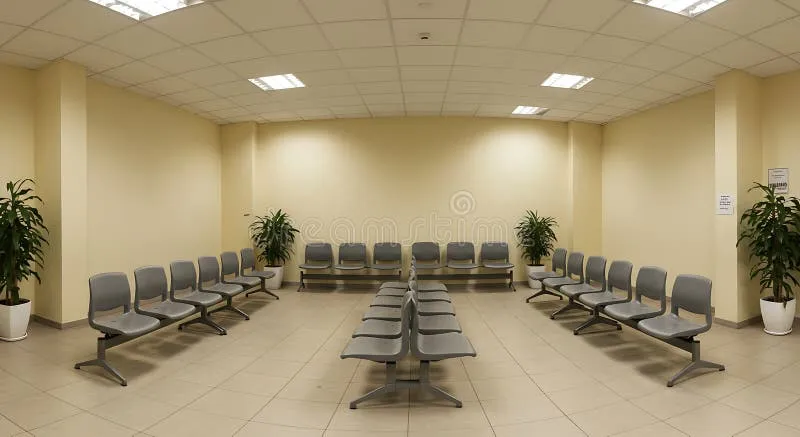
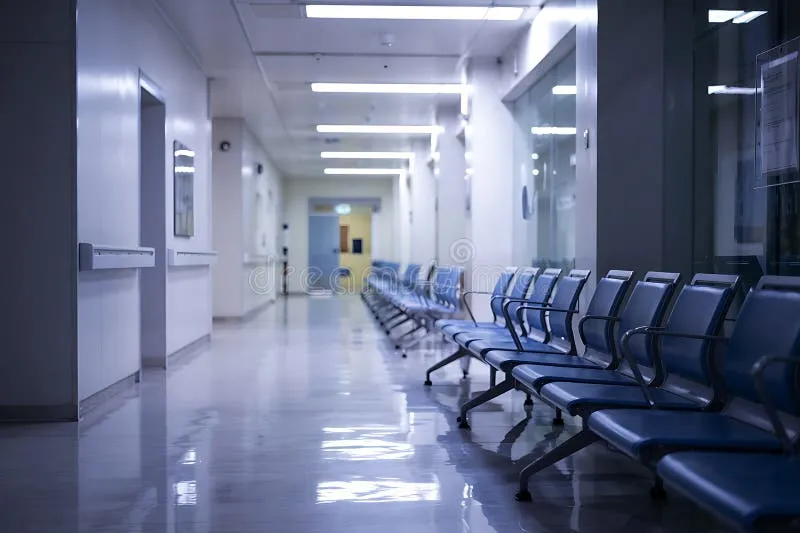
Photo: empty DMV waiting room fluorescent lights rows of chairs, via thumbs.dreamstime.com
The first thing Denise Mallory noticed was that the chairs didn't match.
She had worked the license renewal counter at the Harwick County Department of Motor Vehicles for eleven years. She knew the waiting room the way you know a room you have spent most of your waking life inside — the water stain above ticket dispenser three, the particular groan of the HVAC when it cycled off at four-fifteen, the angle of the afternoon light through the frosted glass panels that made every face in the waiting area look faintly posthumous. She knew the chairs. Blue molded plastic, riveted to aluminum frames in rows of eight, forty-eight total. She had counted them more than once.
Sometime in the spring of the year she would later describe only as "the year things started feeling wrong," a new section of seating appeared past the double doors at the far end of the room. Nobody announced it. There was no memo, no facilities work order she could locate, no contractor presence she recalled. The chairs in this new section were a slightly different shade — not quite the same blue, closer to the color of old pool water — and they were arranged in rows of ten. She counted thirty of them the first time. Forty-six the second. She stopped counting after that.
The Measurements That Didn't Agree
The Harwick County DMV occupies a single-story annex attached to a municipal services building constructed in 1987. The external footprint of the annex, as recorded in county building permits on file with the planning office, is approximately 4,200 square feet. This figure has not been amended. No addition permits have been filed.
Internal maintenance records tell a different story.
A facilities work order dated three years after the chairs appeared requests a square-footage assessment of the waiting area in preparation for a flooring replacement. The contractor's measurement, logged in the same document, places the waiting area alone at 6,800 square feet. A follow-up inspection note, appended in different handwriting, reads: measurement disputed — could not locate south wall from east entry point. Recommend re-measure. There is no record of a re-measurement.
A second facilities note, filed roughly eight months later by a different contractor, references "the extended corridor seating" and requests clarification on whether the space falls under the main annex's fire suppression zone or a separate system. The request was routed to county facilities management. The response, if one was ever sent, is not in the file.
Testimony from the Counter
Denise Mallory is not the only long-term employee to have noticed.
Roger Castellan, who operated the commercial license window for fourteen years before taking early retirement, described the expansion in terms that were careful and precise in the way that people become careful and precise when they are afraid of not being believed. "I want to be clear that I am not saying anything supernatural," he said in a recorded interview. "I'm saying that the room I worked in for fourteen years did not have the same dimensions in year fourteen that it had in year one. I am saying that I walked to the back of that waiting area once, in my last year, and I walked for longer than I should have. The room kept going. The fluorescent lights kept going. The chairs kept going. I turned around and walked back."
He paused.
"I didn't tell anyone. What would I have said?"
A third employee, who requested anonymity and currently still works at the facility, described the smell of the extended section as distinct from the rest of the building. "Like a motel carpet after it's been wet," she said. "Not bad, exactly. Just — present. And there's a sound back there. Not loud. Like the hum of a vending machine that isn't there."
Citizens Who Waited and Cannot Return
The more disquieting dimension of this account is not architectural.
Over the past several years, a pattern has emerged in online forums dedicated to local civic complaints — the kind of threads that begin with genuine frustration about wait times and DMV bureaucracy and occasionally veer into territory that is harder to categorize. Multiple users, writing independently across different platforms and different years, describe variations of the same experience: they visited the Harwick County DMV for a routine transaction, were directed to the extended seating area, waited for what felt like an ordinary amount of time, completed their business, and left. When they subsequently attempted to return — for a forgotten document, a second appointment, a follow-up — they could not locate the building.
Not the annex. The building. The municipal services complex that has occupied the same address since 1987.
One user wrote: I drove the route I've driven a dozen times. The street is there. The parking lot is there. There's a building. But it isn't the right one. I don't know how to explain that. It looks close. It isn't right.
Another, more tersely: Waited two hours in a room that goes back further than it should. Got my license. Can't find the place again. Starting to think that's fine.
What the Building Knows
Structural analysis of anomalous spaces within the Backrooms literature consistently identifies a threshold phenomenon: the moment at which a built environment stops reflecting the intentions of the people who constructed it and begins reflecting something else. Something that finds human architecture useful for its own purposes, which are not human purposes, and which expands according to a logic that has no relationship to zoning law, fire code, or the load-bearing capacity of a 1987 municipal annex.
The chairs in the extended section of the Harwick County DMV are, by all available accounts, always occupied.
Nobody has confirmed who is sitting in them.
Denise Mallory, when asked whether she ever looked closely at the people waiting in the back section, was quiet for a long moment before answering.
"I made a decision," she said, "not to."
She did not elaborate. She did not need to.