Appointments Without End: Tracing the Clinic That Exists Between Scheduled Hours
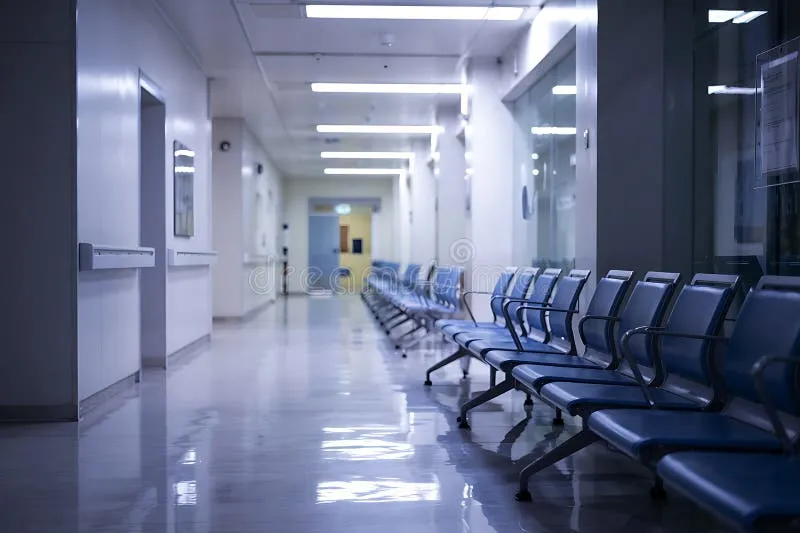
Photo: empty medical waiting room fluorescent light mauve chairs, via thumbs.dreamstime.com
The appointment card reads 2:15 PM. It is printed on cardstock the color of old teeth, with a logo that resembles a caduceus if you don't look at it directly. Below the time, a street address: 4881 Harrow Medical Plaza, Suite 11. The city is listed. The zip code is listed. Neither the city's planning office nor the US Postal Service has any record of the suite existing.
That card was recovered from the belongings of a woman in Akron, Ohio, who reported that she had attended an appointment at a facility she could not locate on any map after the fact. She remembered the drive. She remembered the parking lot — asphalt with faded yellow lines, a lone shopping cart pressed against a concrete barrier. She remembered checking in at a laminate desk and sitting in a waiting room where the chairs were the particular shade of mauve that only appears in medical facilities built between 1987 and 1995. What she could not account for was the time.
She had arrived, she believed, at 2:10 PM. When she returned to her car, her phone read 7:44 AM — the following morning.
This is not an isolated account.
The Records That Don't Resolve
Over the past several years, this publication has collected seventeen separate testimonies from individuals across nine states who describe attending medical appointments at facilities they cannot subsequently locate or verify. The accounts share a consistent texture: the offices are unremarkable to the point of being oppressive in their ordinariness. Drop ceilings with the occasional water stain. A fish tank with no fish, only a slow aerator churning cloudy water. Magazines on a side table — issues of People and Better Homes & Gardens from years that feel slightly wrong, not old enough to be nostalgic, not recent enough to be current.
In each case, the patient received what they describe as a complete appointment. They were seen by a physician. Vitals were taken. Notes were made. In eleven of the seventeen cases, prescriptions were written on paper bearing the clinic's letterhead — a name that varies slightly between accounts: Harrow Medical Group, Harrow Associates Clinic, Harrow & Partners Family Practice. The prescriptions reference medications with plausible-sounding names that do not appear in any pharmaceutical database this publication has been able to consult.
The insurance claims are perhaps the most disorienting artifact. Three of the seventeen patients filed claims with their respective insurers for the visits. Two of those claims were processed. One was paid out — $180 for a standard office visit, billed under a provider NPI number that, when queried through the CMS National Plan and Provider Enumeration System, returns a name that is sixteen characters of what appears to be corrupted text.
What the Waiting Room Holds
The waiting room, in nearly every account, is where time begins to misbehave.
Patients report sitting for what feels like minutes and emerging to discover hours have passed, or conversely, spending what subjectively feels like an entire afternoon in the waiting room — reading, watching a muted television broadcasting a cooking program they cannot name — only to check their phones upon leaving and find that fewer than four minutes have elapsed. One patient from outside Memphis described the waiting room television in precise detail: a woman in a yellow apron was making something with phyllo dough, and the program had no chyron, no network watermark, no identifying information of any kind.
The chairs are always the same. The carpet — and every account mentions the carpet — is always a low-pile commercial weave in a pattern of muted geometric shapes, slightly damp underfoot in a way that no one can attribute to any visible source.
No one, in any account, remembers another patient in the waiting room when they arrived. Most report that by the time they were called back, they had forgotten to notice whether anyone else was there.
The Address That Moves
The street address printed on appointment cards, letterheads, and prescription slips has been submitted to this publication in seven distinct forms across the seventeen accounts. The street name is always some variation of Harrow — Harrow Medical Plaza, Harrow Drive, Harrow Commons — but the street number changes, the city changes, and in two cases the state changes, though the patients in question are certain they did not cross state lines to attend their appointments.
A researcher attempting to verify the address for this article drove to the location listed on one patient's appointment card in a mid-sized Ohio city. She found a strip mall. The anchor tenant was a mattress store that had been closed for at least two years, judging by the paper covering the windows and the sun-bleached GOING OUT OF BUSINESS banner still stretched across the facade. Suite 11, according to the unit numbering still visible above the doors, should have been the third unit from the left. The door was there. The handle was there. The door did not open, and when she pressed her ear to the surface, she reported hearing, faintly, the sound of an aerator churning water.
She did not try the handle a second time.
What Treatment Means Here
The question this publication cannot answer with confidence is whether the patients who attended these appointments received any form of genuine medical care — or whether the appointments themselves were a structure designed to accomplish something else entirely.
Several patients report feeling better after their visits in ways they struggle to articulate. One man, who attended what he believed was a follow-up for a persistent shoulder injury, says the pain resolved completely after the appointment. He has no memory of any treatment being performed, no paperwork documenting a procedure, and his shoulder bears no marks. He also reports that for approximately three weeks following the visit, he had difficulty distinguishing between rooms he had been in before and rooms he was entering for the first time — a spatial disorientation he describes as mild but persistent, like a compass that has lost its north by a few degrees.
Two patients report the opposite: they left feeling measurably worse, not in any specific physical sense, but with a generalized sense of wrongness that they cannot locate in their bodies, only somewhere adjacent to them.
The prescriptions, in every case where a patient attempted to fill one, were declined. The medications did not exist. The prescribing physician's DEA number was not on file. The paper itself, in two cases, had become illegible by the time the patient reached the pharmacy — not smudged, not wet, simply blank, as if nothing had ever been written on it.
The appointment cards, however, remain legible. Every one of them. The time, the address, the name of the clinic, crisp and clear on cardstock the color of old teeth.
Several of the patients still have their cards. None of them have thrown them away.
None of them have been able to explain why.