The Work That Never Finishes: Inside the Renovation Crews Nobody Hired Twice
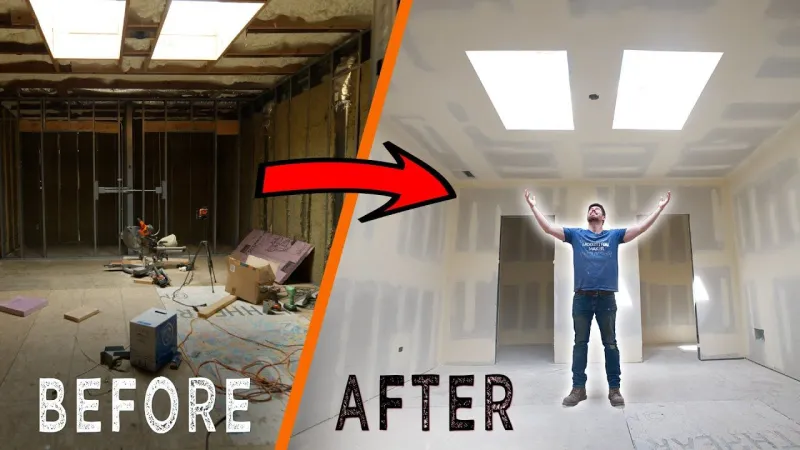
Photo: unfinished drywall construction interior renovation abandoned, via i.pinimg.com
The smell reaches you before the sound does. Joint compound and sawdust and something underneath both of those — something older, the smell of a space that has been opened and left open, exposed to a draft that has no clear origin. Then the sound: a circular saw running in a room that is one room too far away to see, the brief shriek of blade on material followed by silence, followed by the saw again.
If you follow the sound, the room is always empty by the time you reach it. The work, however, is always present: fresh cuts in lumber, drywall screws driven to the dimple, wire pulled through conduit and stripped at the end, ready for a connection that has not been made. The tools are sometimes there. The workers are not.
This is the condition that has been reported, in strikingly similar terms, across eleven documented cases spanning six states and the better part of a decade. In each case, a building — residential or commercial, occupied or transitional — entered a state of renovation that has never concluded and shows no sign of concluding. The same phases of work repeat. The same materials appear. And in the cases where witnesses have observed the crews performing the labor, the descriptions that emerge are close enough to constitute a pattern that this publication does not know how to explain.
Permits That Contradict Themselves
In seven of the eleven cases, building permits were pulled for the renovation work. This is itself unusual — renovation work of ambiguous origin rarely generates a paper trail — but more unusual is what those permits contain.
In a commercial building in suburban Columbus, Ohio, a permit for interior renovation was filed in March of 2019. The same permit, with the same permit number and the same project description but a different contractor name, was filed again in September of 2021. The city's building department has no record of either permit being closed out with a final inspection. A third filing, discovered by a researcher for this publication in the county's digitized records, appears to be dated 2017 — two years before the first filing — and describes work that is word-for-word identical to the later two.
The contractor names listed across these three permits do not match. Two of the three contractor license numbers, when queried with the Ohio Construction Industry Licensing Board, return no results. The third returns a license that expired in 2003, belonging to a company that dissolved that same year.
The work described in all three permits — non-load-bearing partition walls, electrical rough-in for a commercial kitchen, plumbing rough-in for a three-compartment sink — has been observed in progress in the building on at least four separate occasions by the building's current owner. On each occasion, the crew performing the work left before the owner could speak with them. On each occasion, the work had advanced slightly from the previous visit. On no occasion has the work progressed beyond the rough-in phase.
The partitions have never been finished. The electrical has never been connected to a panel. The plumbing has never been tied in. The building's current owner reports that the materials in the affected space do not age in the way she would expect — the drywall shows no yellowing, the lumber no warping, the wire no oxidation — despite years of exposure to an unheated interior.
The Crew
Witness descriptions of the renovation crews are where this investigation becomes difficult to present without qualification.
In five separate cases, witnesses who observed workers in the affected spaces describe the same crew with a consistency that exceeds what coincidence or common trade-uniform convention can account for. A lead worker, described uniformly as a man in his mid-fifties, heavyset, wearing a canvas work vest over a gray thermal shirt, a pencil behind his left ear. Two additional workers, younger, whose faces witnesses consistently struggle to recall with precision — not because the witnesses are uncertain, but because, as several of them phrase it independently, there is nothing to hold onto. The faces are present. They simply do not leave an impression.
The lead worker, in three separate accounts from three separate states, was seen making a mark on a wall with a carpenter's pencil. In none of these accounts did a witness see what was being marked. In all three, the mark — when later examined — was a measurement notation in a format none of the witnesses recognized: numbers separated by a symbol that was not a standard fraction bar.
No witness has successfully initiated conversation with any member of the crew. In the cases where a witness approached, the workers were gone by the time the witness entered the room. In one case, a property manager in Atlanta entered a space mid-morning to find the crew actively working, and reports that she stood in the doorway for what felt like a full minute watching them before walking in — at which point the room was empty, the tools were on the floor, and the saw that had been running was cold.
The Half-Finished State
What the renovation work shares across all documented cases, beyond the personnel and the permits, is an arrested quality — a state of incompletion that is too consistent to be incidental.
Drywall is hung but never taped. Electrical is roughed in but never connected. Plumbing is stubbed but never pressure-tested. These are not the signs of a project that ran out of money or was halted by an inspector. These are the signs of a project that reached a specific threshold and stopped — not abandoned, but paused, held at the exact moment before one phase of work gives way to the next.
In construction, that threshold has a name. It is called rough-in. It is the stage at which the structure is prepared to receive its systems but has not yet received them. The building is opened up. Everything is accessible. Nothing is committed.
This publication does not speculate lightly. But the pattern across these eleven cases suggests that whatever process is responsible for this work is not interested in completing it. The value, if there is a value, appears to lie in the state of being almost ready — in the space that has been opened and prepared and left waiting for something that has not yet arrived and may not be coming.
The saw runs in the next room.
By the time you reach it, the room is empty.
The work is fresh.