Ledgers for the Unlisted: The Accounting Anomalies That Point Toward a Parallel Corporate Infrastructure
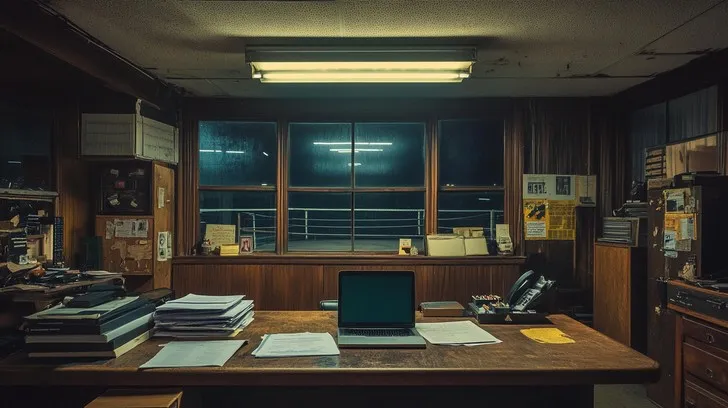
Photo: night office desk accounting documents fluorescent light, via images.stockcake.com
Accounting, at its core, is an act of faith. You trust that the numbers in a ledger correspond to something real — a transaction, a person, a service rendered. The entire architecture of corporate finance rests on that correspondence. A line item means something happened. A payroll entry means someone was paid. A department code means people worked somewhere under a name, toward a purpose that someone, at some point, approved.
What the witnesses in this investigation describe is a breach in that correspondence. Not fraud — fraud implies intent, implies a human agent manipulating the record for gain. What they found does not appear to have been created for anyone's gain. It appears, in several cases, to have been created for no discernible reason at all, by no discernible hand, and to have been accumulating quietly inside ordinary corporate filing systems for years.
We have spoken with nine former accounting professionals across six industries. Their accounts follow.
The Discovery, and How It Tends to Happen
There is a reason this phenomenon is associated almost exclusively with night shifts. During standard business hours, accounting departments operate under conditions that are not, practically speaking, conducive to noticing anomalies: deadlines, supervisors, the constant incoming traffic of invoices and approvals and correction requests. The work is too loud, in the administrative sense, for silence to surface.
Night shifts are different. The floor empties. The overhead lights cycle down to their after-hours minimum. The work becomes a person alone with a screen and a database, running audits or reconciling figures or preparing reports for morning review. In that quiet, the wrong entries become visible.
Patricia H., a former senior accountant at a logistics firm in suburban Chicago, describes her discovery during a quarterly reconciliation in the winter of 2014. She was cross-referencing payroll disbursements against active employee IDs when she encountered a cluster of ID numbers that fell outside her company's standard formatting — not by much, a single additional digit at the end — but enough to flag as irregular. The IDs were attached to names. The names were attached to salary figures. The salary figures had been disbursing, according to the records, for eleven years.
"There were forty-three of them," she said. "Forty-three employees. All with job titles I didn't recognize — not titles from our company's structure, not even titles from our industry, really. Things like 'Continuity Associate' and 'Ambient Review Specialist' and one that just said 'Interval.' Just the one word. Like that was the whole job."
She escalated the finding to her supervisor the next morning. An internal investigation was opened. The salaries, when traced, did not correspond to any bank account on file. The disbursements appeared to have gone somewhere, but the destination was, in the language of the investigation's final report, "unresolvable within current system architecture."
Patricia left the firm eight months later. She did not cite the incident as the reason. She did not need to.
The Departments That Shouldn't Be There
Payroll anomalies are the most common variety reported, but they are not the only one. Several witnesses describe discovering entire department codes — the internal identifiers that route expenses and assign resources — with no corresponding documentation in any company record.
Robert A., a former internal auditor at a mid-size pharmaceutical distributor in New Jersey, found a department code during a system migration in 2018 that had been present in the company's accounting software since at least 2003 — the earliest records available after a server consolidation. The code had its own budget line. It had received and spent money consistently across fifteen years. The expenditures were categorized under headings like "Spatial Maintenance," "Threshold Monitoring," and, in a quarterly report from 2009, "Ambient Correction — Level 3."
"I thought at first it was a legacy code from an acquisition," Robert said. "We'd absorbed a couple of smaller companies over the years, and sometimes those integrations leave orphaned codes in the system. But when I pulled the acquisition records, none of them had anything like this. The code didn't come from anywhere. It had just always been there."
The department code was deleted during the migration. Robert reports that three months later, a new code appeared in the system with a slightly different number but identical expense categories. He left the company before the next audit cycle.
What the Records Describe
Several witnesses were willing to share specific details from the anomalous records they encountered, and those details, taken together, sketch something that resists easy categorization.
The expense reports, where witnesses examined them closely, describe activities that are bureaucratically coherent — formatted correctly, categorized properly, approved through what appears to be a standard internal workflow — but whose content is difficult to parse. Reimbursements for "transit through non-standard corridors." Supply requests for materials listed only by alphanumeric codes with no corresponding vendor or product description. Overtime claims filed for shifts logged at hours that do not exist on a standard clock — one report, photographed by a witness before deletion, listed a shift as beginning at 11:58 PM and ending at 11:43 PM, a duration of negative fifteen minutes, with overtime calculated at the standard rate.
One witness, a former accounts payable specialist at a regional insurance company in the Pacific Northwest, describes an expense report in which the location field — typically a city and state — read only: "Yellow. Fluorescent. Level ongoing." The report was otherwise fully completed. It had been approved by a supervisor whose employee ID, when she searched it, returned no name.
The Question of Intent
Fraud investigators and forensic accountants operate on the assumption that financial anomalies have human authors. Someone created the entry. Someone routed the money. Someone benefits. The investigative framework is built on that assumption, and it is, in the vast majority of cases, correct.
The cases described here resist that framework. The witnesses who investigated them found no evidence of human authorship — no login records corresponding to the entry dates, no IP addresses, no approval chains that terminated in a real person's credentials. In Patricia's case, the internal investigation concluded that the payroll entries had been "self-populating," a phrase the report did not define and did not revisit.
What this publication is prepared to suggest — carefully, with full acknowledgment that the evidence is circumstantial — is that these records may represent something like administrative overflow. The Backrooms, as documented across hundreds of witness accounts, appears to maintain its own internal logic, its own systems of organization and persistence. It has corridors and rooms and lighting and, apparently, something that functions like time. It is not unreasonable to ask whether it also has something that functions like administration. Whether the bureaucratic infrastructure of the spaces described by witnesses — the break rooms, the offices, the filing cabinets full of documents no one remembers creating — generates its own records, and whether those records occasionally surface in the filing systems of the world above.
If so, someone is logging the hours. Someone is tracking the expenses. Someone, or something, is maintaining a ledger for operations conducted in spaces that should not exist, staffed by personnel no HR department has ever onboarded.
The books, it appears, are being kept. Whether they are being kept for us, or simply in spite of us, is a question the numbers alone cannot answer.
All witnesses interviewed for this article requested anonymity. Identifying details, company names, and geographic specifics have been altered or withheld. Documentation submitted to Backrooms Lore is retained in secure storage.