The Break Room at the End of the Hall: A Narrative Account of Workers Who Stepped Away and Didn't Step Back
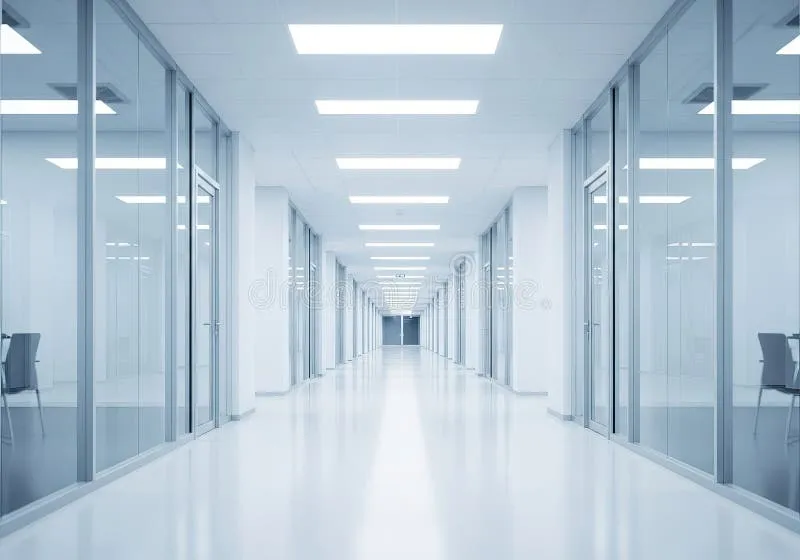
Photo: empty office break room fluorescent lighting long hallway, via thumbs.dreamstime.com
Every office has a room that no one thinks about. It is at the end of a hallway, or past the copier, or through a door that is always slightly ajar. It contains a microwave with something dried onto the interior ceiling, a refrigerator with a handwritten note about labeling your food, a table with chairs that don't quite match. It smells like coffee that was made several hours ago and never quite stopped being made. It is, in the taxonomy of workplace architecture, a non-space: a room that exists in service of the moments between work, which are themselves in service of work, which means the break room exists in service of nothing anyone has ever fully articulated.
It is, in other words, a threshold. And thresholds, as any student of this subject understands, require attention.
The accounts gathered here were not solicited through any formal research channel. They arrived — through tip submissions, through employment verification requests that were forwarded to this publication by a third party whose identity we have agreed not to disclose, through a single manila envelope postmarked from a zip code that the USPS has no record of issuing. They are fragmentary. Several are unsigned. All of them describe the same essential experience, in different buildings, in different cities, across what appears to be a span of at least fifteen years.
A woman who identifies herself only as a former administrative coordinator at a mid-sized insurance firm in Columbus, Ohio describes her experience in a written statement that runs to three pages, the last of which is partially illegible due to what appears to be water damage.
"The break room on our floor was at the end of the east corridor," she writes. "I went there every day for four years. I knew it the way you know a room you've been in a thousand times — not consciously, just as a fact of your body. On the day I'm describing, I went for coffee around 10:15. I remember pouring it. I remember the chair I sat in. I do not remember anything after that until I was standing in the parking garage, and it was dark, and my phone said it was 11:47 p.m. My shift had ended eight hours earlier. I had no messages. No one had called looking for me. When I came in the next morning, my manager asked if I'd felt better. I didn't know what she meant. She said I'd gone home sick the previous afternoon. I had not gone home sick. I had gotten coffee."
Her employment records, obtained through a verification request filed under a former employer's FMLA documentation process, show a gap of three days around the date she describes. The gap is not annotated. There is no sick leave entry, no PTO request, no disciplinary note. The days simply do not appear in the payroll record. She was paid for them regardless.
A facilities technician who worked at a corporate campus in suburban New Jersey describes something slightly different — not lost time, but a spatial inconsistency he has never been able to resolve.
"The break room on the third floor was where I ate lunch for about two years," he writes. "One afternoon I went in and it was bigger. Not dramatically — not like a warehouse. Just bigger. The table was farther from the door than it should have been. There was a hallway to the left of the vending machines that I had never seen. I stood there for a minute looking at it. It went back maybe thirty, forty feet and ended in a door. The door had one of those little wire-glass windows in it. I walked toward it. I stopped about halfway. There was a light on the other side of the glass. Not fluorescent — something yellower, warmer. And there was a sound coming from behind the door that I can only describe as the sound of a lot of people talking in a room, all at once, but very quietly, so you can hear the talking but not any of the words."
He did not open the door. He left the break room, ate lunch at his desk, and returned to the third floor the following day to find the break room its correct size, the vending machines against the correct wall, no hallway. He asked a colleague whether the room had always been laid out the way it currently was. The colleague said yes, always, why?
He filed no formal report. He did not know what category such a report would fall under.
The severance documents are perhaps the most formally troubling element of this collection. Three separate packets — from unrelated companies, in unrelated industries, in unrelated states — contain identical anomalies: a termination date that falls on a Sunday (none of the three companies operates on Sundays), a final paycheck stub showing hours worked that exceed the number of hours in the pay period by a margin that ranges from eleven to, in one case, forty-three hours, and a "reason for separation" line that reads, in all three documents, "voluntary departure from premises."
Not voluntary resignation. Not voluntary termination. Departure from premises.
The HR contacts listed on all three documents are unreachable. Two of the phone numbers have been reassigned to unrelated businesses. The third rings without connecting.
What these accounts share is not drama. There is no confrontation, no creature, no obvious moment of horror. What they share is a quality of wrongness that is almost administrative in its presentation — a gap in the record, a room that doesn't match its own dimensions, a door at the end of a hallway that no floor plan acknowledges. The break room is where these workers went to stop working, and in stopping, they paused at a threshold that most people cross without noticing.
Most of them came back. Their accounts suggest they are aware, in a way they cannot fully articulate, that coming back was not guaranteed — that the break room they returned from was not precisely the break room they entered, and that somewhere, in the geometry of a building they thought they knew completely, there is a door with a wire-glass window and a warm yellow light on the other side of it.
And behind the door, if you are quiet enough to hear it: the sound of many people talking, all at once, very softly.
None of them saying anything you can make out.
All of them, perhaps, on break.