The Assembly Point: Collected Testimonies from Office Workers Who Gathered in a Parking Lot That Would Not Stop Growing
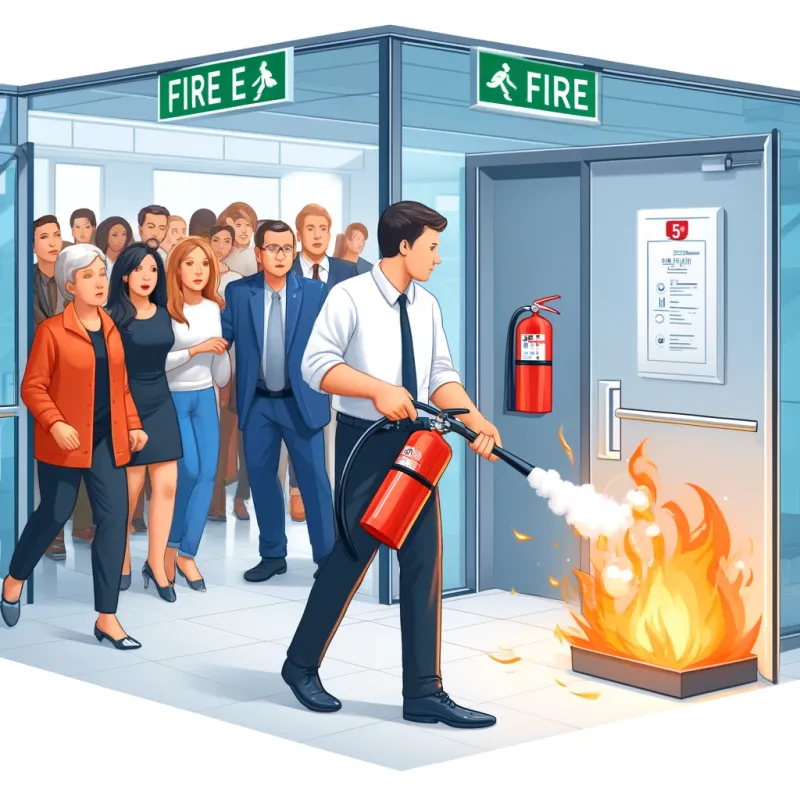
Photo: office workers fire drill empty parking lot overcast sky, via kenmarfire.com
Between 2017 and 2023, this archive received six independent accounts from individuals across three American cities who describe a structurally identical experience: a routine workplace fire drill that led them outside to a designated assembly point that subsequently expanded, thinned, and quietly ceased to resemble the world they had left. The accounts share no obvious connection — different employers, different cities, different years. What they share is the specific horror of institutional compliance, and the unsettling suggestion that the Backrooms most reliably claims people who are simply doing what they were told.
The testimonies reproduced below have been lightly edited for clarity. Names have been changed or withheld at submitters' request. Identifying details — employer names, precise addresses — have been omitted in accordance with this archive's standard editorial policy.
On Compliance as Vulnerability
There is a particular cognitive posture that workplace safety culture produces in American office workers, and it is worth naming before examining the accounts themselves. The fire drill, as an institution, is designed to suppress individual judgment in favor of collective procedural response. You do not evaluate the alarm. You do not assess whether the situation warrants your attention. You stand, you follow the nearest exit signage, you proceed to the designated assembly point, and you wait to be told that it is safe to return. The entire architecture of the exercise is built on the suspension of critical observation.
This archive has documented, across dozens of case studies, that spatial displacement events share a common precondition: the subject's attention is elsewhere at the moment the threshold opens. The fire drill is, in this sense, an almost perfectly calibrated delivery mechanism. It moves large numbers of people through unfamiliar exit routes, deposits them in outdoor spaces they have rarely examined closely, and then instructs them to stand still and wait. It asks them, explicitly, not to think too hard about their surroundings.
The Six Accounts: Common Features
All six submitters report that the displacement did not feel like an event. It felt like a gradual wrongness — a slow accumulation of details that did not resolve into alarm until the accumulation had become undeniable.
Four of the six report that the building behind them appeared to be the wrong color. Not dramatically wrong — not red where it should have been gray, or glass where it should have been brick. Wrong in the way that a building looks when you have seen it every day for three years and then seen a photograph of it taken by a stranger: correct in every measurable detail and somehow not the building you know.
All six report the absence of ambient street noise. This is the detail that appears first in every account, often before the submitter has identified it as significant. One submitter, a paralegal from a mid-sized firm in Columbus, Ohio, writes: I remember thinking it was unusually quiet for a Tuesday afternoon, and then I remember thinking that I had been thinking that for a while and hadn't done anything about it. The silence in these accounts is not total — it is the specific silence of a space from which the expected sounds have been subtracted. Traffic noise. HVAC hum from adjacent buildings. The ambient urban texture that American city-dwellers absorb so completely they cease to hear it until it is gone.
 Photo: Columbus, Ohio, via dynamic-media-cdn.tripadvisor.com
Five of the six report that their group of coworkers appeared to thin over the course of the drill without anyone visibly departing. This is perhaps the most unsettling feature of the collected accounts, and the most difficult to explain through conventional means. The submitters are consistent in their description: they did not see anyone leave. They looked away, or looked down at their phones, or spoke briefly to a colleague, and when they looked back the group was smaller. Not dramatically smaller — never half the size in a single glance. One fewer person. Then two fewer. The subtraction was incremental and patient.
None of the six can account for how they returned inside. All six report that they were eventually back at their desks, that the all-clear had apparently sounded, and that the remainder of the workday proceeded normally. None of the six reported the experience to HR, their manager, or building security. Several note, with varying degrees of self-awareness, that they did not report it because they were not certain what they would have said.
Partial Transcript: Account Six
The following is reproduced from an audio recording submitted by a project coordinator at a logistics company in suburban Atlanta. The recording was made approximately six hours after the incident, on the submitter's personal phone. It ends without resolution. No follow-up communication has been received from this individual.
— and I kept counting, because that's what you do, right, you account for everyone, that's the whole point of the drill, and I was at seventeen and then I was at fourteen and I hadn't seen anyone go back inside, I would have seen that, the door was right there, and the door looked right but the sign above it was, I don't know, the sign was —
[pause, approximately four seconds]
— the sign was in the right font. That's the thing. It was in exactly the right font. And I remember thinking that if someone had replaced the sign they would have gotten the font right, they would have been careful about that, and I don't know why I was thinking about whether someone had replaced the sign but I was standing there thinking about it and the parking lot was, it felt like if I walked to the far end of it I would walk for a long time before I reached —
[recording ends]
This archive notes that institutional compliance — the trained suppression of individual observation in favor of procedural behavior — may represent the most significant and least-examined vulnerability in documented displacement events. The alarm sounds. You follow the signs. You proceed to the assembly point. You wait.
You do not look too carefully at the building behind you.
You do not count the people standing next to you.
You wait to be told it is safe to go back inside.