Retail Without Exit: Survivor Accounts from Shopping Malls That Folded Space Around Their Visitors
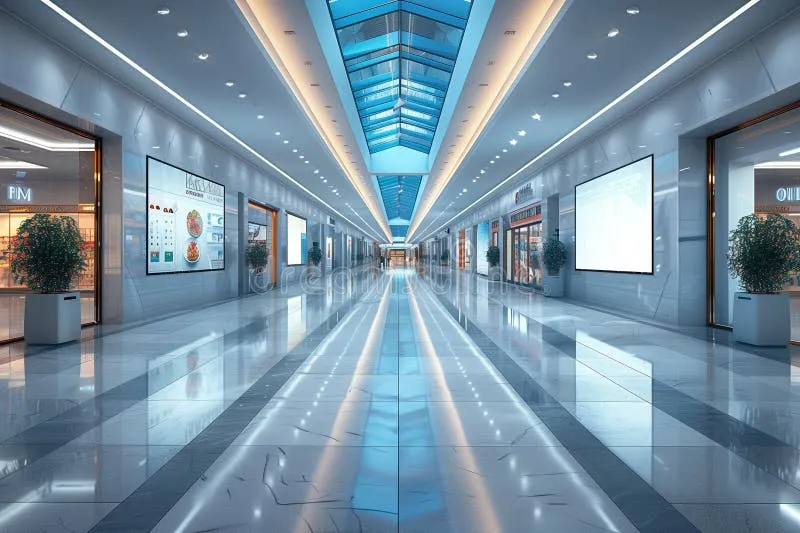
Photo: empty shopping mall corridor fluorescent lights perspective, via thumbs.dreamstime.com
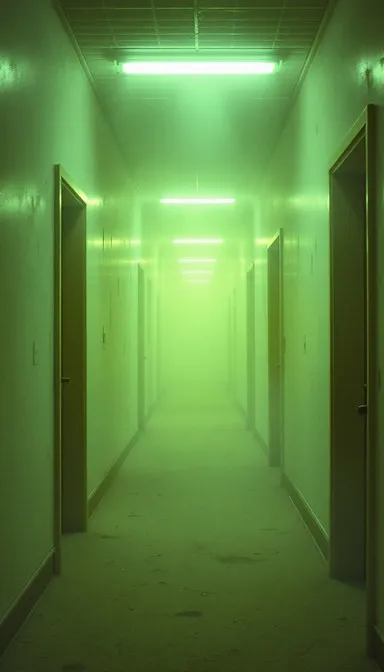
The first thing most of them mention is not the looping. It is the quality of the light.
Not dim, exactly. Not malfunctioning in any way a facilities manager would write up. Just slightly wrong — the particular yellow-white of fluorescent tubes that have been burning for longer than fluorescent tubes are designed to burn, casting everything in a pallor that makes the storefronts look like photographs of storefronts. Like facsimiles. Like something that studied retail spaces from a great distance and reproduced the surface without fully understanding the purpose.
This detail appears, unprompted, in twenty-three of the thirty-one accounts collected for this analysis. The witnesses did not know each other. The malls they described were in Ohio, Georgia, Nevada, Minnesota, and seven other states. Several of the facilities in question have since closed. At least two are still operating.
We are not ready to say what that means. We are documenting what was reported.
The Geometry of a Standard Regional Mall
To understand what witnesses describe as wrong, it helps to understand what is supposed to be right. A standard enclosed American shopping mall follows a logic that is almost aggressively legible: anchor stores at either end of a central corridor, satellite retail filling the spine between them, food courts positioned to capture foot traffic at natural decision points. Every design choice is oriented toward navigation. You are never supposed to feel lost. The entire architecture is an argument against getting lost.
This is why the accounts are so disorienting to read. The spaces these witnesses describe are not abandoned malls, not decaying malls, not malls in the process of closing. They are operational malls, staffed and lit and stocked, with Muzak cycling through overhead speakers and other shoppers visible at the edges of sight. The wrongness does not announce itself. It accumulates.
Marissa D., a 34-year-old elementary school teacher from outside Columbus, Ohio, entered a regional mall on a Saturday afternoon in March 2019 to return a pair of shoes. She describes walking past the anchor department store, past a bath products retailer, past a phone carrier kiosk, and arriving at the food court — where she turned around to retrace her steps and found herself walking past the same bath products retailer again, then the same phone carrier kiosk, then the same anchor store. She assumed she had turned around incorrectly. She turned around again. The sequence repeated.
"The third time I passed the candle store," she wrote in the account she submitted to this publication, "I noticed the candles were different colors than they'd been the first time. Not all of them. Just some. Like something had been adjusted between my passes. Like someone was making small changes and watching to see if I'd notice."
She found an exit after approximately forty minutes. She estimates she covered the same two-hundred-foot corridor segment no fewer than nine times.
The Escalator Problem
Of all the architectural elements witnesses describe behaving incorrectly, escalators appear most frequently in the accounts — and the descriptions are consistent enough to constitute a pattern.
In a functioning mall, an escalator moves in one direction. It is either ascending or descending. This is not a complex mechanical proposition. And yet, across fourteen separate accounts from nine different facilities, witnesses describe escalators that appeared to move in both directions simultaneously, or that moved in the expected direction while depositing riders on the same floor they had departed, or — most commonly — that descended regardless of which end the witness boarded from.
Thomas R., a former retail manager from suburban Atlanta, describes boarding what he believed to be an ascending escalator on the ground floor of a two-story mall. The escalator moved upward. He rode it for what he estimates was forty-five seconds, which he notes is far longer than the ride should have taken. He stepped off onto a floor that appeared to be the ground floor. The anchor store visible from the top of the escalator was identical to the anchor store visible from the bottom. He rode the same escalator four more times before abandoning the attempt and finding a stairwell, which also, he notes, took him longer to ascend than the number of steps should have required.
"I kept counting the steps," he said in a phone interview. "There were always between eighteen and twenty-two. But it kept taking me longer to get to the top. Like the steps were spacing themselves out as I went up. Like the stairwell was stretching."
Stores That Repeat, Imperfectly
The variation detail — the sense that repeated spaces are not exact copies but slightly adjusted versions — appears in roughly forty percent of accounts and is, arguably, the most unsettling element of the phenomenon. Simple looping could be attributed to disorientation, to the repetitive visual language of retail design, to stress or fatigue. Variation cannot.
Witnesses describe clothing stores in which the mannequins have been repositioned between passes. Food court restaurants in which the menu boards display different prices, or different items, or in two cases items written in no recognizable language. A toy store in which the toys in the window display appeared progressively older on each pass — not vintage, witnesses clarify, but aged, as though time inside the window was moving at a different rate than time in the corridor outside it.
One account, submitted anonymously by a former mall security guard, describes walking the same wing of a Midwestern mall for an entire overnight shift and cataloguing the changes he observed in a store selling athletic footwear: the number of shoes on display decreased by one pair on each circuit. By the end of his shift, the shelves were empty. By the time he completed one final pass before clocking out, the shelves were full again, with different shoes.
He does not work in retail security anymore. He did not explain why in his submission, and we did not press.
Access Points or Random Events
The question this publication returns to most frequently, across all the phenomena we document, is whether these events are patterned or arbitrary — whether certain physical locations or architectural configurations create reliable thresholds, or whether the threshold opens wherever and whenever it chooses.
The mall accounts offer no clean answer. Geographically, the facilities are distributed without obvious clustering. Architecturally, they range from 1970s-era enclosed malls to early 2000s lifestyle centers. No single retail tenant, construction firm, or design company appears in every case. The events do not correlate reliably with season, time of day, or reported foot traffic.
What does correlate, weakly but persistently, is a construction or renovation history. Twenty of the thirty-one facilities had undergone significant interior renovation within five years of the reported incident. Three had been partially demolished and rebuilt. Whether renovation creates access points, or merely reveals them, is not a question current evidence can answer.
What we can say is this: if you are in a mall and the light looks older than it should, and you pass the same store twice, and the escalator takes longer than the escalator should take — do not assume you are confused. You may be confused. But you may also be somewhere that is using the architecture of a familiar place to hold you in a space that is not quite that place, observing the small changes you make and making small changes of its own.
Find an exterior door. Not a stairwell. Not an escalator. A door that opens onto a parking lot, onto daylight, onto the specific and irreplaceable texture of the outside world.
And if the parking lot looks like it has been there longer than it should, move quickly.
Accounts referenced in this article were submitted voluntarily to Backrooms Lore. Identifying details have been altered at witness request. Facility names are withheld pending ongoing review.