Powered by Nothing: The Impossible Fluorescent Lights That Every Backrooms Witness Describes the Same Way
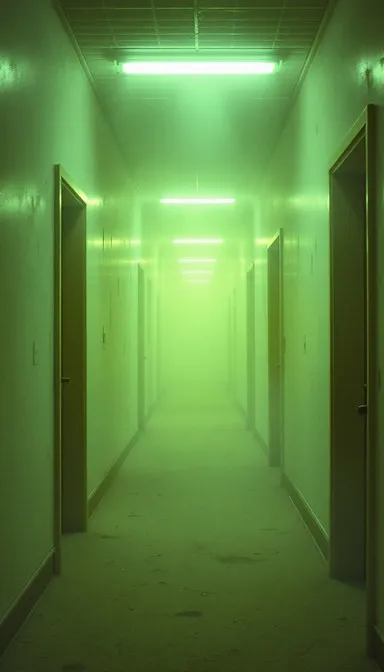
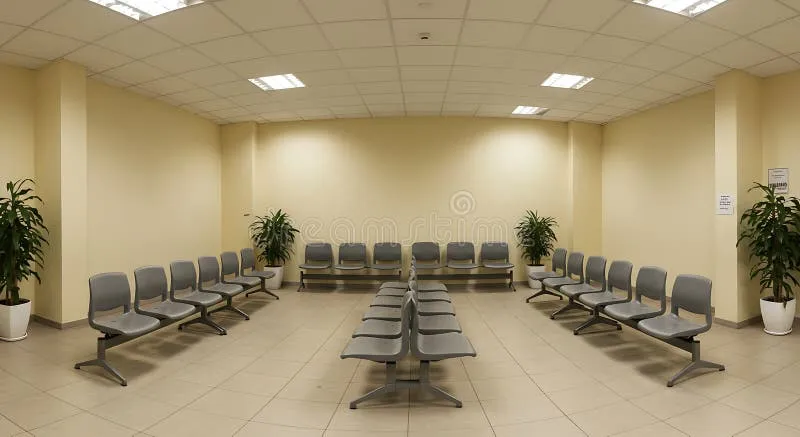
Photo: flickering fluorescent lights empty office corridor institutional building, via images.stockcake.com
The Light That Should Not Be
There is a particular quality to fluorescent light that most people never consciously register. It is not warm. It is not natural. It occupies a frequency range that the human eye processes as functional rather than comfortable — bright enough to work by, wrong enough to make the skin look slightly wrong, the walls slightly off. In the Backrooms, that quality is amplified into something closer to a threat.
Of the several hundred first-person accounts collected and cross-referenced by researchers at Backrooms Lore over the past several years, an overwhelming majority — preliminary tallies suggest upward of 94 percent — describe ceiling-mounted fluorescent fixtures as the primary or sole light source encountered during a no-clip event. This figure would be unremarkable if these accounts were describing the same building, the same region, or even the same decade. They are not. They span geographic locations across at least thirty-two U.S. states, multiple countries, and time periods ranging from the early 1990s through the present. The consistency is not a coincidence. It is a pattern, and patterns in threshold architecture are never accidental.
What the Witnesses Actually Describe
The accounts are worth examining in their specificity, because it is the specificity that unsettles. Survivors do not simply report "lights." They report fixtures of a particular vintage — roughly consistent with commercial fluorescent installations common in American office buildings and institutional spaces constructed between 1970 and 1995. Recessed rectangular housings. Frosted or yellowed plastic diffuser panels. Tubes arranged in pairs. A flicker that is not quite rhythmic, not quite random, occupying an intermediate frequency that several witnesses have described as feeling intentional.
The hum is the detail most frequently mentioned without prompting. A low, continuous electrical sound, described variously as a "wet buzz," a "pressure behind the ears," and, in one account from a survivor who spent an estimated eleven hours in Level 0, as "the sound a building would make if it were trying to breathe quietly." Audiologists consulted informally on these descriptions suggest the hum corresponds to standard 60-Hz electrical resonance — the frequency of the North American power grid. This is notable because no power grid connection has ever been identified in any confirmed Backrooms space. There are no conduits. No breaker panels. No utility easements. No infrastructure of any kind that would explain a functioning electrical system. The lights run on nothing, and they run on it consistently.
The Shadow Problem
Photographic evidence presents its own complications. A substantial portion of images submitted to this publication and to parallel documentation projects over the years show lighting conditions that are internally inconsistent — shadows falling at angles that do not correspond to the visible fixture positions, illumination levels that appear uniform in ways that no point-source lighting arrangement could produce, and a general flatness to the light that several photographers have noted feels "composited" rather than natural. One forensic imaging consultant, reviewing a set of forty-three photographs independently, noted that the light in the images appeared to have no discernible origin point. "It's as though the room itself is luminous," she wrote in her assessment. "The fixtures may be decorative."
This possibility — that the fluorescent lights are not actually the source of the light, but rather a feature the Backrooms deploys to make its spaces feel recognizable — has circulated in the research community for some time. It is worth taking seriously. The Backrooms, in every documented configuration, presents itself as a degraded version of human institutional space. Drop ceilings. Commercial carpeting. Painted drywall. Loading corridors. Break rooms with coffee makers that are always slightly too warm to the touch. The fluorescent fixture is among the most legible symbols of that aesthetic. It says: this is a place where people work. This is a place where someone, at some point, made decisions about infrastructure. You are not in the wilderness. You are in a building.
Whether that message is meant to comfort or to deceive remains an open question.
Maintenance That Never Happened
Fluorescent tubes burn out. Under normal operating conditions, a standard T8 or T12 fluorescent lamp has a rated lifespan of roughly 20,000 hours — approximately 833 days of continuous operation. In the Backrooms, no burned-out tube has ever been reliably documented. Accounts occasionally describe flickering fixtures, but the flicker is described as behavioral rather than mechanical — a response to presence, to movement, to the proximity of certain entities — rather than the simple degradation of an aging lamp. The tubes, by all available evidence, do not age. They do not fail. They continue producing light in spaces that have no maintenance schedule, no replacement parts, no custodial staff.
This is not how fluorescent lighting works. This is not how any lighting works.
A Feature, Not a Flaw
The most productive framework for understanding the fluorescent constant may be architectural rather than electrical. Threshold spaces — the lobbies, corridors, waiting rooms, and transitional zones that occupy the boundary between defined human activity and undefined emptiness — share a design vocabulary that has been largely standardized across American institutional construction for the past half-century. The fluorescent fixture is part of that vocabulary. It signals a category of space: managed, monitored, temporarily occupied. It implies, without stating, that someone will be along shortly.
In the Backrooms, that implication is the cruelest part. The lights suggest habitation. They suggest that the space is maintained, that it is known, that it exists within a system of oversight. They are, in this reading, not a light source at all. They are a promise that the Backrooms makes and never intends to keep — the architectural equivalent of a phone that rings but never connects, a door that opens onto another door, a hallway that ends where it should begin.
The lights stay on. They will stay on after you leave, if you leave. They were on before you arrived. Whatever they are powered by, it is not electricity, and it is not indifference. The consistency is too precise for indifference.
Document everything. The hum especially. The hum is the part that changes last.