Damp Without Source: The Wet Carpet Phenomenon and What It May Be Carrying Back
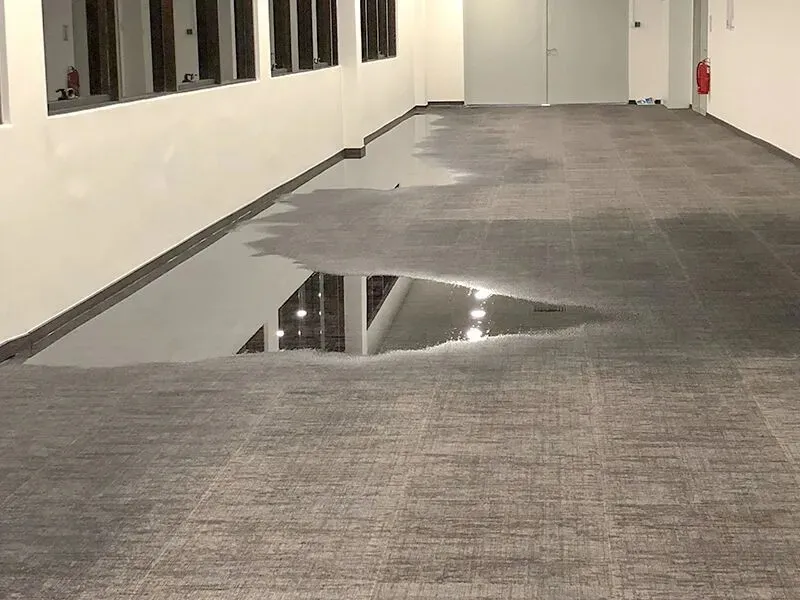
Photo: wet carpet water damage empty office building fluorescent light, via www.puroclean.com
Before the Water, There Is the Smell
It arrives before anything visible. Witnesses consistently report the olfactory experience preceding any physical evidence by minutes, sometimes hours — a low, damp, mineral scent that does not belong in the space they are occupying. A records storage facility in Albuquerque, New Mexico, sealed for renovation and located in a high-desert environment averaging twelve inches of annual precipitation, documented the smell in three separate internal inspection reports before any moisture was physically measured. Staff described it as "a basement that isn't there," "an old swimming pool," and, in one report that was not included in the facility's official documentation but was obtained through a public records request, "the inside of a place that has been waiting."
The smell of the Backrooms has been described with remarkable consistency across survivor accounts. Wet commercial carpet. Mildew at a low, chronic level — not the acute reek of active water damage, but the ambient dampness of a space that has been slightly wrong for a very long time. Institutional cleaning product layered over biological moisture, the way a hospital corridor smells at 3 a.m. when no one has mopped recently but someone did, once, and the memory of it hasn't entirely left the floor.
That smell is appearing in places that have no business smelling that way.
The Inventory of Impossible Moisture
This publication has spent the better part of eight months cross-referencing reports of anomalous moisture events in facilities that share at least one characteristic: they are located in environments or structural conditions that should preclude moisture accumulation, and they have no documented plumbing failure, no roof breach, no HVAC condensation event, and no geological water table access that could explain what was found.
The cases cluster in ways that are difficult to dismiss as coincidence. Six of the eleven most thoroughly documented incidents occurred within eighteen months of a reported no-clip event in the same facility or an immediately adjacent structure. Three occurred in buildings that had previously been flagged in separate, unrelated investigations for anomalous spatial readings — interior dimensions that did not correspond to exterior measurements, rooms that appeared on early-stage blueprints and were subsequently absent from final construction documents, corridors that building staff avoided without being able to articulate why.
In a Phoenix, Arizona, office complex — a climate-controlled structure with a sealed subfloor and no basement level — maintenance workers documented wet carpet extending approximately forty linear feet from a conference room that had been locked and unoccupied for six weeks. The moisture penetrated to the subfloor. Samples sent to an environmental lab returned results that the lab's report described as "consistent with long-term water exposure in an organic-fiber substrate" — meaning the carpet had been wet, by the lab's assessment, for a minimum of several months. The room had been locked for six weeks. The carpet had been installed eleven months prior. The arithmetic does not resolve.
Algae Where Algae Cannot Grow
The Phoenix case is notable for a secondary finding that appears in at least four other documented incidents: biological growth consistent with algae or algae-adjacent organisms in spaces with no light source sufficient to support photosynthesis. The growth is typically pale — almost colorless, described in one report as "the color of something that used to be green" — and presents in thin films along baseboards, beneath carpet seams, and in the grout lines of floor tiles. Standard environmental remediation protocols have proven inconsistently effective. In two cases, the growth returned within weeks of professional treatment, presenting in slightly different locations but at comparable density.
Mycologists and environmental biologists consulted on several of these cases have expressed difficulty categorizing the organism. It shares morphological characteristics with common environmental molds and with certain freshwater algae, but its growth pattern does not conform to either. It does not appear to require a consistent moisture source. It does not appear to require light. What it does appear to require — and this is speculative, based on the geographic and temporal clustering of cases — is proximity to a threshold.
Displacement or Absorption
Two competing hypotheses have emerged from the research community attempting to make sense of these incidents. The first holds that moisture is being displaced — that the Backrooms, operating as some form of non-Euclidean interstitial space, occasionally bleeds its environmental properties into adjacent waking-world structures, particularly those that share architectural characteristics with Backrooms Level configurations. The wet carpet smell, in this reading, is not produced by the building. It is imported from somewhere else, seeping through a boundary that is thinner than it should be.
The second hypothesis inverts this: that certain buildings are not receiving Backrooms properties but developing them. That the moisture, the smell, the pale biological growth, and the spatial anomalies documented in these facilities represent a process of architectural convergence — a building slowly becoming something it was not designed to be, absorbing characteristics from a category of space it was never meant to resemble.
Both hypotheses are troubling. The first suggests that the Backrooms is close enough to touch. The second suggests that the boundary between threshold space and constructed space is not fixed — that a building can drift, over time, toward something worse.
What the Carpet Remembers
There is a quality to wet commercial carpet that is almost impossible to fully dry. The moisture retreats from the surface but persists in the backing, in the pad beneath, in the subfloor if the exposure has been long enough. Remediation professionals describe this as the carpet "remembering" the water — a colloquial phrase, not a technical one, but accurate in its implication. The moisture leaves a record of itself even after it is gone.
The facilities in this investigation have been remediated, in most cases. The carpet has been replaced. The tiles have been regrouted. The biological growth has been treated. But the smell, in several instances, has not entirely left. It is faint. It is present only in certain weather, or at certain hours, or when the building is quiet enough that there is nothing else to notice.
It smells like a place that has been waiting. It smells like somewhere you have not been yet.