Room 412 Is Always Occupied: Hotel Staff and the Guest Who Never Checked In
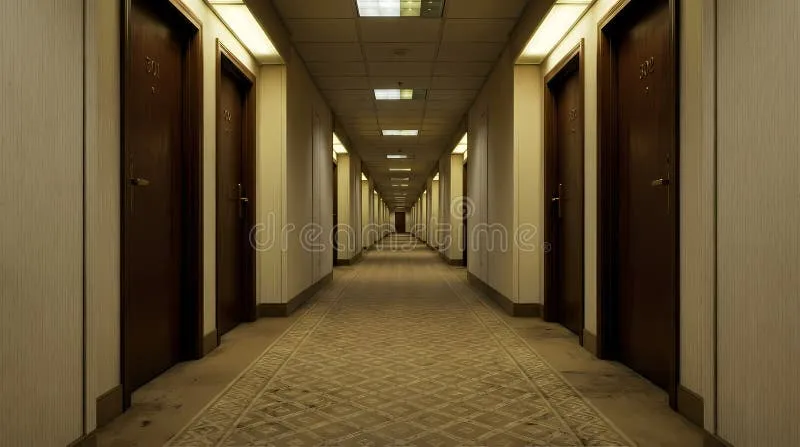
Photo: hotel hallway corridor fluorescent lights closed doors empty, via thumbs.dreamstime.com
The housekeeping cart stops at 412 every morning.
This is what Patricia Venn, a room attendant at a mid-sized business hotel outside Columbus, Ohio, described as the first thing she understood about the situation. Not a choice. Not a habit born of superstition. The cart stopped at 412 the way a dog stops at a fence line — not because it had been trained to stop there, but because something beyond the fence had communicated, in a register below language, that stopping was correct.
She would stand for a moment. She would listen. Then she would move on.
"There was always a sound," she said. "Very quiet. Like someone breathing, but slower than breathing. Like the room itself was breathing. I never knocked. I don't think knocking would have been right."
The Record That Isn't There
The phenomenon Patricia describes is not unique to her property, her chain, or her region of the country. Over the past several years, hospitality workers across a range of hotel brands — budget extended-stay properties, mid-scale business chains, at least two full-service hotels in major metro areas — have reported variations of the same experience with a consistency that is difficult to attribute to coincidence or shared mythology.
In each account, the room in question is occupied in every practical sense. The door hanger indicating "Do Not Disturb" is sometimes present; more often, there is simply a quality to the door that communicates the same message without requiring a sign. The room appears in the property management system as available. No reservation is attached to it. No guest name. No credit card on file. No check-in timestamp.
When housekeeping does enter — on the rare occasions when a supervisor insists, or when a new employee who hasn't yet learned the unspoken protocol opens the door — the room is found to be in a state that defies easy description. Clean, by all appearances. Bed made. Towels folded. And yet not quite unused. Staff describe it as the difference between a room that has been cleaned and a room that has never been dirty — a distinction that sounds semantic until you have stood in both kinds of room and felt the difference in the air.
The air in these rooms is described, repeatedly and independently, as slightly warm. And there is always a sound.
What the Sound Is
The acoustic reports surrounding these rooms constitute a pattern worth examining on their own terms.
The sound is not loud. No account describes anything that could be heard from the hallway without deliberate listening. It is the kind of sound that becomes audible only when the corridor is otherwise quiet — late at night, in the early morning hours before the breakfast service begins, during the dead middle of a Tuesday afternoon when the property is running at thirty percent occupancy and the ice machine on the fourth floor is the loudest thing in the building.
Carers describe it variously as: a low, continuous hum at a frequency just below comfortable hearing; a sound like a television playing in another room, but without the rhythm of speech or music, just the carrier tone; a sound like someone moving slowly across carpet, but continuous, never resolving into distinct footsteps; and — most frequently, across the widest range of accounts — a sound like someone exhaling, very slowly, that never transitions into an inhale.
Daniel Okafor, a night auditor at an extended-stay property in suburban Atlanta, described the sound in terms that have remained with every person he has shared them with. "It's the sound of a room that doesn't know it's supposed to be empty," he said. "It's still doing whatever it was doing before. It never stopped."
He worked night audit for six years. For four of those years, room 308 at his property was, by his accounting, never vacant. He checked the system every shift. The room was always listed as available. He never entered it. He never assigned it to a guest. He told one supervisor, who told him the system had a known bug that sometimes failed to clear old reservations. He did not believe this explanation. He did not argue against it.
Theories from the Floor
Hospitality workers, by professional necessity, are skilled observers of human behavior and highly attuned to the rhythms of occupancy — who is in which room, what they need, when they are likely to leave. It is this professional attunement that makes their theories about the phenomenon worth considering, not despite their lack of formal credentials but because of their experiential ones.
The most common theory, shared in some form by the majority of workers interviewed, is one of temporal persistence: the idea that certain rooms have been occupied for so long, by so many people, that occupancy has become a permanent condition of the space rather than a temporary state of it. The guest is not a specific person. The guest is what the room has become.
A second theory, less common but more specific, holds that the rooms in question predate the hotels that contain them — that the buildings were constructed around spaces that were already, in some sense, claimed. That the property management system lists them as available because the system can only see what the hotel owns, and the hotel does not own room 412. Room 412 is on loan.
Patricia Venn, who has since transferred to a different property, does not speculate about causes. She is focused on effects.
"Before I left," she said, "I started noticing that the sound had changed. It was still quiet. But it was — closer to the door. Like whatever was making it had moved toward the door. Like it knew I was there."
She paused. The pause was long.
"I put in for the transfer the next morning. I don't know if I was right to. I don't know if distance helps with something like that. I think about room 412 more now than I did when I was standing outside it. That might mean the distance doesn't help. Or it might mean that I left too late."
She did not elaborate on what she meant by too late. The interview ended there.