Clocked In, Never Out: Security Personnel Testimonies on Shifts That Refused to End
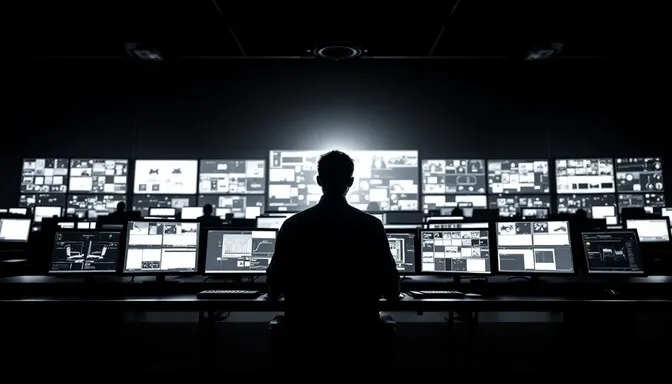
Photo: dark security monitoring station multiple screens night shift, via images.stockcake.com
The security booth is, by design, a place of waiting. A small room. A bank of monitors. A logbook. Coffee going cold in a styrofoam cup. The entire architecture of the overnight security shift is built around the premise that nothing will happen — and that someone must be present to confirm that nothing is happening. It is, in this way, one of the most liminal occupations a person can hold: a watcher stationed at the threshold between order and its absence.
Which may explain why, across the accounts gathered here, it is always security personnel. Always the watchers.
The incident reports compiled in this piece were sourced from a range of facilities — a distribution warehouse in Dayton, Ohio; a mid-rise office complex outside Atlanta; a decommissioned federal records annex in central Virginia — all of which share two characteristics. First, the companies that contracted their security services no longer exist in any traceable form. Second, every officer who filed an anomalous report did so using timestamps that do not correspond to any verifiable point in time.
Marcel D., who worked an overnight rotation at a logistics facility sometime in the mid-2010s, described the onset of what he called "the long part of the shift" as a gradual rather than sudden event. His written account, recovered from a personnel file associated with a security contracting firm whose business license lapsed under circumstances the relevant state agency describes only as "administrative irregularity," reads as follows:
*"I noticed around 2 a.m. that the monitors were cycling the same views they had been cycling at 1 a.m. Not similar views. The same. I could see my own reflection in monitor four — I had been scratching my neck — and the reflection was doing it again at 2:07. I checked the recording system. The timestamp said it was live. I called the front desk. No one answered. I called again. The phone rang the same number of times as the first call, then stopped. I looked at the clock on the wall. It said 2:09. I looked again, a long time later, and it still said 2:09." *
Marcel's logbook contains forty-seven entries between 2:09 a.m. and what he eventually recorded as 6:00 a.m. — his scheduled end of shift. The entries are detailed. They describe patrol routes he walked, sounds he heard in the east corridor ("a low hum, not mechanical, more like a room thinking"), and a door at the far end of the building that he noted was open on three separate walkthroughs despite being listed as sealed in the facility's own maintenance records. He describes walking toward the door twice and not reaching it. He does not describe what happened the third time. The entry simply ends mid-sentence.
He clocked out at 6:02 a.m., two minutes past shift end, consistent with normal procedure. His supervisor at the time reported that Marcel arrived at the following week's briefing looking "a lot older than I remembered him being," and that he resigned without explanation approximately ten days later.
The camera loop phenomenon Marcel described is not unique to his account. Testimonies from at least four other officers, gathered from unrelated facilities in unrelated states, describe an identical progression: a monitor cycling footage that is indistinguishable from live, a timekeeping device that stops advancing, and a pervasive quiet that is not the absence of sound but rather the presence of something that sounds like silence and isn't.
One officer, whose name was redacted from her incident report at her own written request, described the quality of that sound with unusual precision. "It was like the room was holding its breath," she wrote. "Not empty. Holding. There's a difference. Empty rooms don't have any pressure to them. This one had pressure."
She also described, in the same report, a growing certainty that the monitors were not showing her the building she was sitting inside. The angles were wrong. The hallways were longer. In one feed — camera seven, covering a storage corridor on the building's second floor — she noted a section of wall that she had never seen during any physical patrol, a stretch of paneling that extended past where the building's exterior should have been.
"I walked the second floor four times that night," she wrote. "Camera seven showed a hallway I never found."
What is notable about these accounts, beyond their content, is their consistency of affect. These are not panicked reports. They are methodical, logged in the careful, declarative language of people trained to observe and record without editorializing. The dread in them is not performed. It accumulates the way dread accumulates in a real place — slowly, in the margins, in the pauses between sentences.
The Dayton warehouse produced the most extensive record: a full shift log spanning what the timestamps indicate is eleven hours, filed by an officer whose employment record shows a single three-day engagement before the contracting company's records go dark. In the final third of the log, the entries become shorter. More fragmented. The handwriting changes — not dramatically, but in the way handwriting changes when someone is very tired, or very frightened, or both.
The last entry reads: *"Something on monitor three. Not walking. Present. I am going to stay at the desk." *
There is no entry after that. There is no clock-out record.
The psychological literature on temporal disorientation in confined, low-stimulus environments is well-established. Sensory monotony distorts time perception. Isolation amplifies minor anomalies into significant ones. These are real phenomena, and they almost certainly account for some portion of what these workers experienced.
But they do not account for the camera feeds. They do not account for the hallway that extended past the building's edge. They do not account for the thing on monitor three that was not walking.
What these accounts suggest, taken together, is not a failure of perception. They suggest a failure of geometry — a monitoring station that was, at some point during the shift, no longer monitoring the building it was built to watch. That the watchers found themselves stationed at the threshold of something else entirely, and that some of them, without moving, crossed it.
The security booth is a place of waiting. It is possible that some of these officers are waiting still.