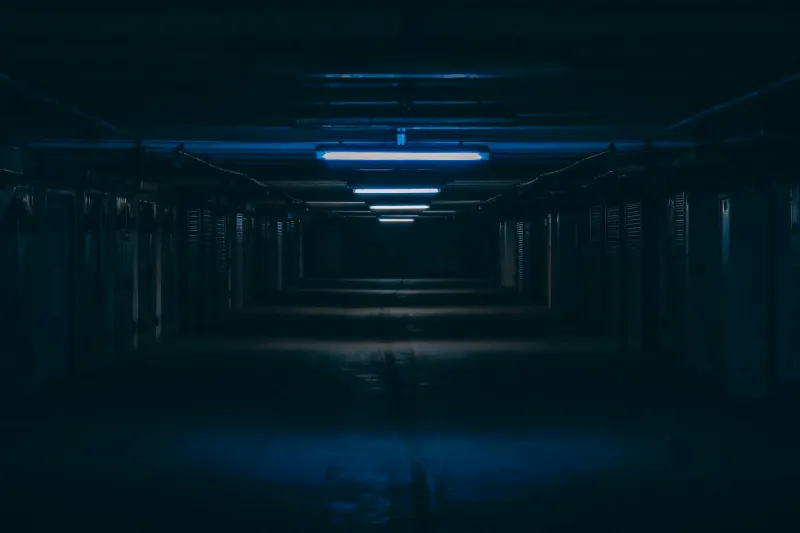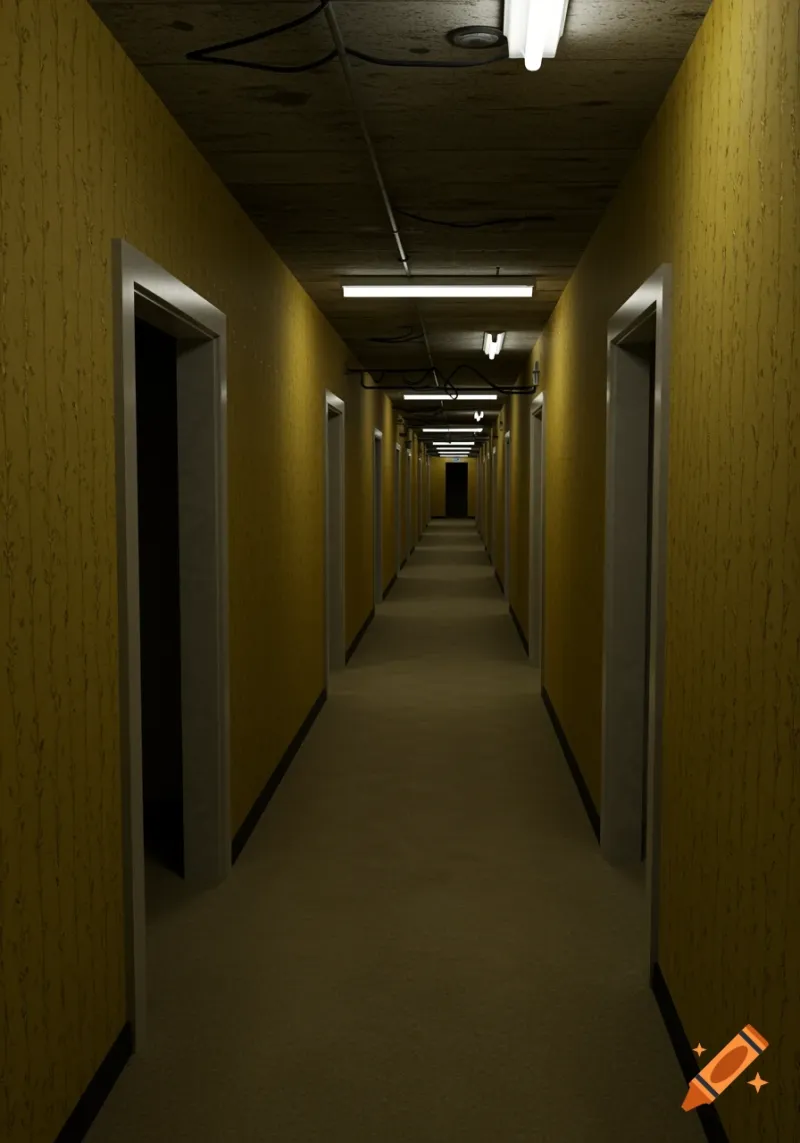
The fluorescent bulbs hummed their familiar tune as Marcus pressed his ear against the yellowed wall. Three days since he'd walked through what should have been his apartment door and found himself here—wherever here was. But it wasn't the lights that made him listen. It was the silence underneath.
"The quiet has weight," he would later tell investigators. "Like it's pressing down on you, waiting for something."
Marcus's testimony joins a growing archive of firsthand accounts from individuals claiming to have experienced displacement into what researchers now term "acoustically impossible spaces." These witnesses, separated by geography and often years, describe identical auditory phenomena that challenge our understanding of how sound behaves in enclosed environments.
The Breathing Hum
Across seventeen documented cases, subjects report a consistent low-frequency drone that seems to "breathe" with their movements. Sarah Chen, a Portland architect who disappeared for four days in 2019, described it as "the sound of the building thinking." Her account mirrors that of James Rodriguez, a Detroit maintenance worker whose experience occurred two years earlier and 2,300 miles away.
"It would get louder when I stopped moving," Rodriguez explained during his interview. "Not immediately—it would wait, like it was making sure I wasn't going anywhere. Then it would swell up from the walls themselves."
Acoustic analysis of these testimonies reveals a troubling consistency. The described frequency range—between 40 and 60 Hz—falls within the range known to induce anxiety and disorientation in humans. Yet witnesses report the sound as somehow "aware," responding to their presence rather than emanating from mechanical sources.
Footsteps in Empty Corridors
Perhaps more unsettling are the reports of footsteps that mirror the subject's own gait with impossible precision. Twelve separate witnesses describe hearing their footfalls echoed back to them from distances that should not exist in the spaces they occupied.
"I would take three steps, then stop," recalled Linda Vasquez, a nurse from Phoenix. "Two seconds later, I'd hear three steps from somewhere ahead of me. Same rhythm, same weight. But when I called out, the steps would stop too."
Dr. Michael Thornton, who has studied these accounts for the National Institute of Mental Health, notes that such auditory mirroring typically occurs only in specific architectural conditions—large, empty spaces with parallel walls and hard surfaces. "The problem," he explains, "is that these subjects describe hearing the effect in spaces they claim measured only eight feet wide."
The Distant Conversations
Most disturbing are the reports of distant voices—conversations that seem to occur just beyond hearing range, stopping the moment the listener attempts to approach or even focus on them. These accounts share an eerie specificity: the voices always sound familiar, often resembling family members or close friends.
Marcus described following what sounded like his sister's laughter for what felt like hours. "It was definitely her laugh—the way she giggles when she's nervous. But every time I got close to a corner where it seemed to be coming from, it would stop. Complete silence. Then it would start up again, somewhere else."
These testimonies suggest something beyond simple auditory hallucination. The consistency of reported experiences, combined with the specific behavioral patterns of the sounds themselves, points toward environmental factors that remain poorly understood.
Sound as Surveillance
The most chilling aspect of these accounts may be their implication: that silence itself functions as a form of attention in these spaces. Witnesses consistently report feeling "listened to" during periods of complete quiet, as if the absence of sound carried its own intelligence.
"The worst part wasn't the humming or the footsteps," Chen explained. "It was when everything went completely quiet. That's when you knew something was watching."
This sensation of being observed through silence appears across cultures and backgrounds, suggesting a fundamental aspect of these acoustic environments rather than psychological projection. The silence, witnesses claim, has texture—it presses against them, evaluates them, responds to their emotional state.
Implications for Understanding
These testimonies, while unverified, paint a picture of spaces where sound behaves according to unknown principles. The consistency of reports across unconnected individuals suggests either a shared psychological response to extreme stress or the existence of acoustic phenomena that operate outside conventional physics.
What emerges from these accounts is not merely the story of people lost in impossible places, but evidence that these places may be actively aware of their presence. The sounds—and the silences—described by witnesses suggest an environment that listens, learns, and responds.
In the words of Marcus, still visibly shaken months after his experience: "I don't think we were alone in there. I think we never are. The silence knows we're there, and it's deciding what to do about it."
The wet carpet beneath his feet, he claimed, never made a sound when he walked on it. But somehow, it was the loudest thing in those endless yellow rooms.