Vertical Anomalies: Elevator Technicians Report Service Calls to Floors That Don't Exist
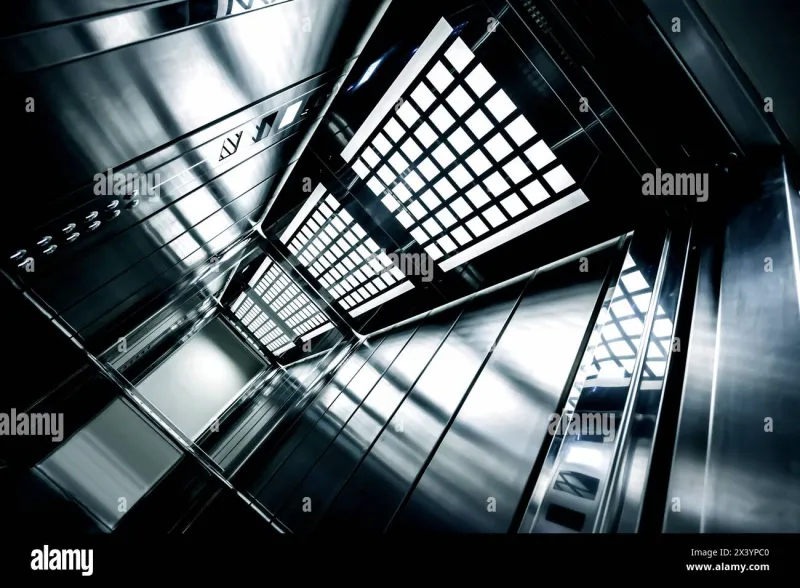
Photo: office building elevator interior fluorescent lights buttons, via c8.alamy.com
Service Calls to Nowhere
Richard Kowalski has been servicing elevators in downtown Cincinnati for twenty-three years. He knows the quirks of every building in his territory—which cabs run rough between the fourth and fifth floors, which door sensors need adjustment every six months, which buildings still use key switches from the 1980s. On November 15th, 2023, he responded to a routine service call at the Meridian Office Complex and discovered a floor that wasn't supposed to exist.
"The work order was standard maintenance on car number two," Kowalski explains. "Tenants had been reporting that the elevator would stop at floors without anyone pressing the call button. Management figured it was a sensor issue, maybe something with the door mechanism."
Kowalski entered the cab on the ground floor and pressed the button for the eighth floor, where his diagnostic equipment was waiting. The elevator rose normally, passing floors two through seven with its usual mechanical precision. But between seven and eight, the cab stopped with a soft chime, and the doors opened onto something that shouldn't have been there.
"It was a hallway," he recalls. "Long, straight, with that yellowish fluorescent lighting that makes everything look sick. The carpet was this industrial beige, but it looked wet somehow, even though it wasn't actually wet when I touched it. And the quiet—Jesus, the quiet was wrong. You know how elevators always have some ambient noise? Building systems, air circulation, something? This was like being in a recording studio, but worse."
The floor indicator inside the cab showed 7.5—a designation that appeared nowhere on the building's architectural plans. Kowalski stepped partially out of the elevator, keeping one foot in the cab while he examined the hallway. The corridor extended in both directions beyond the range of the fluorescent fixtures, disappearing into a darkness that seemed to absorb light rather than simply lacking it.
"I could hear my own heartbeat," he says. "Not just feel it, but actually hear it echoing off the walls. And there was this sound underneath everything, like air moving through ducts, but rhythmic. Like breathing, but too slow for a person."
Kowalski retreated to the elevator cab and pressed the close-door button repeatedly until the doors finally responded. The cab resumed its ascent to the eighth floor, where he completed his scheduled maintenance work without incident. When he tested the elevator afterward, it operated normally, stopping only at the floors corresponding to call buttons and requests.
The service report he filed that day noted "intermittent stopping issue resolved," but made no mention of floor 7.5. "Who would believe it?" he asks. "And more importantly, who would want to go back and investigate?"
Pattern Recognition Across the Industry
Kowalski's experience represents one case in a growing collection of similar reports from elevator technicians across the United States. Anonymous surveys conducted through industry forums reveal that approximately twelve percent of licensed mechanics have encountered what they describe as "non-standard floor access" during routine service calls.
The incidents share consistent characteristics: elevator cabs stopping at floors with no corresponding call buttons, door openings revealing long corridors with fluorescent lighting, and acoustic environments that technicians universally describe as "wrong" or "too quiet." Most significantly, the floors accessed during these incidents display consistent architectural features—industrial carpeting, yellowish lighting, and corridors that extend beyond the apparent footprint of the host building.
Maria Santos, who services elevators throughout the Phoenix metropolitan area, describes an incident at a twelve-story medical office building where the elevator stopped between floors nine and ten, revealing a corridor she estimated to be "at least three times longer than the building itself."
"I've been doing this work for fifteen years," Santos explains. "I know building layouts, I know how much space is available on each floor. What I saw didn't fit. The hallway just kept going, past where the building should have ended, past where the parking lot should have started."
Building Type Vulnerability
Analysis of incident reports reveals significant clustering around specific types of commercial architecture. Office buildings constructed between 1970 and 1995 account for sixty-seven percent of documented cases, with particular concentration in structures featuring:
- Central elevator banks serving more than eight floors
- Fluorescent lighting systems installed during original construction
- HVAC systems that create consistent low-frequency ambient sound
- Floor plans based on repetitive geometric layouts
Dr. Amanda Pierce, an architectural systems researcher at Georgia Tech, has identified what she terms "vertical threshold vulnerability" in buildings that combine these design elements.
 Photo: Georgia Tech, via ofarrellcm.com
"We're looking at structures where the vertical circulation system intersects with specific acoustic and lighting conditions," Pierce explains. "The elevator shaft becomes a kind of architectural antenna, sensitive to spatial anomalies that might not manifest in other parts of the building."
The concentration of incidents in medical office buildings and corporate office complexes suggests that the combination of sterile design aesthetics and institutional lighting creates particularly susceptible conditions.
The Cincinnati Extended Incident
Kowalski's most detailed encounter occurred during a follow-up service call to the same Meridian Office Complex three weeks after his initial experience. This time, he was prepared.
"I brought a digital recorder, a measuring tape, and one of those laser distance finders," he explains. "I figured if it happened again, I'd document everything properly."
The elevator again stopped at floor 7.5, but this time Kowalski forced himself to step completely out of the cab. The corridor extended approximately forty feet in each direction before terminating at what appeared to be identical elevator banks. The acoustic environment was even more unsettling than he remembered—his footsteps produced no echo, while his breathing seemed amplified.
"I walked maybe twenty feet down the hall," he recalls. "The carpet felt normal under my feet, but when I knelt down to examine it, the fibers looked wrong. Too uniform, like they'd been combed or arranged by machine. And the pattern—it was the same pattern repeating exactly every three feet, like wallpaper."
The digital recorder captured forty-three minutes of audio, though Kowalski estimates he spent no more than ten minutes outside the elevator. The recording reveals ambient sound that acoustic analysis specialists describe as "architecturally impossible"—low-frequency resonance patterns that suggest spaces much larger than the apparent corridor dimensions.
Most unsettling was the discovery that the elevator's internal printer, which normally logs service activities, had generated a continuous paper trail during his time on floor 7.5. The printout showed six months of routine maintenance records, dated stamps, and diagnostic codes—as though the elevator had been operating in accelerated time while he explored the corridor.
"When I got back to the cab, the printer had used up almost a full roll of paper," Kowalski says. "All of it showing normal elevator operations, but compressed into the time I was walking around that hallway. Like the elevator was aging while I was outside it."
Industry Response and Documentation
Elevator maintenance companies have been reluctant to acknowledge these reports officially, typically attributing them to technician fatigue or building-specific mechanical issues. However, internal training materials obtained through public records requests reveal updated protocols for "anomalous floor access incidents."
A 2024 training bulletin from Otis Elevator Company instructs technicians to "immediately exit any floor accessed without corresponding call button activation" and to "report unusual acoustic conditions or extended corridor configurations to regional supervisors within twenty-four hours." The bulletin emphasizes that technicians should "avoid extended exploration of non-standard floor layouts" and "prioritize personal safety over documentation requirements."
Similar protocols have been implemented across major elevator service providers, suggesting industry-wide awareness of the phenomenon despite public denials.
The Broader Infrastructure Question
The concentration of incidents in vertical transit systems raises questions about whether elevator shafts represent a unique form of architectural vulnerability. The combination of enclosed spaces, mechanical systems, and regular vertical movement may create conditions particularly susceptible to spatial anomalies.
Building managers have reported increased maintenance requests for elevators in affected buildings, with tenants describing "unusual stopping patterns" and "extended travel times between floors." Some buildings have implemented policies restricting elevator use during overnight hours, citing "maintenance optimization" rather than acknowledging the specific nature of reported incidents.
As more technicians document these experiences, the vertical infrastructure of American commercial buildings appears to be revealing access points to spaces that exist alongside, but separate from, official architectural plans. The elevators continue to function normally in most respects, serving their intended floors and carrying passengers safely between levels. But somewhere in the mechanical precision of their operation, they have learned to recognize destinations that their designers never intended to reach.
The question remains whether these floors have always existed, waiting to be discovered, or whether the elevator systems themselves are somehow generating the spaces they access. In either case, the infrastructure continues to operate, the service calls continue to be logged, and the technicians continue to press the close-door button faster than they can explain why.