
Marcus had been counting steps for three days when he realized the fluorescent lights above him were casting shadows that fell upward.
He stopped walking and pressed his back against the yellow-stained wall, feeling the familiar give of water-damaged drywall beneath his shoulders. The hallway stretched identically in both directions—beige carpet worn thin down the center, ceiling tiles sagging at precise intervals, the persistent electrical hum that had become the soundtrack to his displacement. But those shadows, dark patches pooling on the ceiling instead of the floor, confirmed what his gut had been telling him since he'd started this methodical trek: the rules here weren't just different. They were actively hostile to human navigation.
In the absence of sun, stars, or magnetic north, humans have developed remarkable techniques for finding their way through featureless environments. Cave divers threading through underwater limestone passages rely on guideline protocols and gas management calculations. Submariners navigating beneath polar ice caps employ dead reckoning—the systematic tracking of direction, speed, and time to plot position relative to a known starting point. Desert nomads read wind patterns and sand formations invisible to untrained eyes.
All of these methods share a fundamental assumption: the environment, while hostile, operates according to consistent physical laws.
The Backrooms violates this assumption at every turn.
The Psychology of Spatial Disorientation
Dr. Sarah Chen's 1987 study of sensory deprivation in cave rescue scenarios documented the rapid deterioration of spatial awareness when environmental cues disappear. Test subjects placed in featureless chambers began experiencing "navigation paranoia" within hours—the growing conviction that they were moving in circles despite maintaining straight-line travel. Brain scans revealed hyperactivity in the posterior parietal cortex, the region responsible for spatial processing, as subjects' minds desperately searched for reference points that didn't exist.
 Photo: Dr. Sarah Chen, via cdn.theorg.com
"The human brain is evolutionarily wired to expect certain spatial constants," Chen noted. "Gravity pulls down. Light comes from above. Parallel lines remain parallel. When these expectations are violated, cognitive mapping systems begin to fail catastrophically."
Subjects in Chen's study reported phantom landmarks—doorways that seemed familiar, corridor junctions they were certain they'd seen before, the persistent feeling of being watched from spaces that should have been empty. After 72 hours of isolation, several participants became convinced they were being deliberately led in circles by an unseen intelligence.
Chen's findings take on disturbing significance when applied to documented Backrooms testimonies. The consistent reports of "impossible returns"—wanderers arriving at locations they had definitively left behind, despite maintaining careful directional awareness—suggest that traditional navigation techniques not only fail in this environment but may actively contribute to psychological breakdown.
Dead Reckoning in Dead Space
Marcus had learned dead reckoning during his Coast Guard service, plotting courses across the North Atlantic where GPS signals failed and celestial navigation became impossible during storm systems. The technique required meticulous record-keeping: compass headings, estimated speeds, time intervals, course corrections for wind and current. Every few hours, he would plot his position on a chart, creating a breadcrumb trail of calculated positions leading back to his last known location.
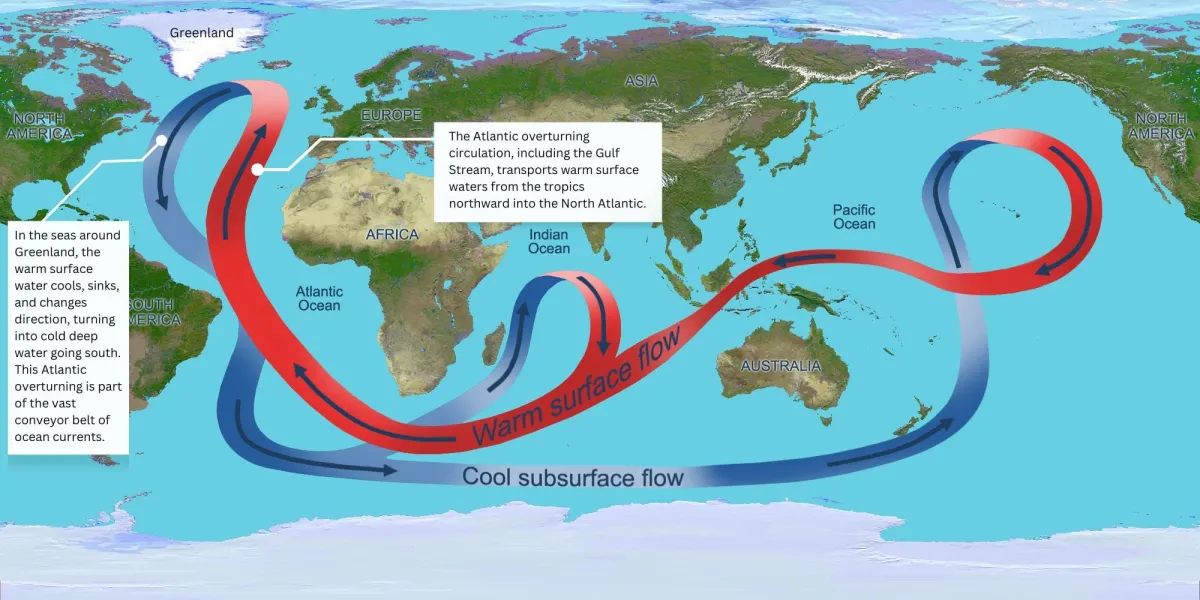 Photo: North Atlantic, via www.geographyrealm.com
He had been applying the same methodology to his Backrooms traverse, using a ballpoint pen to mark walls at regular intervals, counting steps, timing his pace with his wristwatch. But the upward-falling shadows forced him to confront an uncomfortable truth: his careful calculations assumed the corridors remained stationary while he moved through them.
What if the opposite were true?
Submarine navigation accounts for ocean currents that can push a vessel miles off course without the crew's awareness. Cave divers must consider water flow, silt disturbance, and the disorienting effects of nitrogen narcosis at depth. But these are known variables, measurable forces that can be calculated and compensated for.
The Backrooms appear to introduce variables that exist outside conventional physics. Documented cases include corridors that measure different lengths when traversed in opposite directions, rooms that contain more interior space than their exterior dimensions should allow, and the persistent reports of "helpful" entity encounters that guide lost wanderers to safety—only for those same individuals to later discover they have been walking in perfect circles for days.
The Failure of Human Wayfinding
Traditional navigation assumes the existence of a "there" to navigate toward. Maritime dead reckoning plots courses between known ports. Cave diving follows mapped passages toward surveyed exits. Desert navigation moves between water sources and settlements marked by generations of travelers.
The Backrooms may represent the first environment in human experience where the concept of "destination" becomes meaningless. Every door leads to another corridor. Every corridor leads to another room. The architecture generates itself according to rules that seem designed specifically to defeat human spatial cognition.
Marcus stared at the upward shadows for another few minutes, then carefully drew an arrow on the wall pointing in the direction he had been traveling. Below it, he wrote the time: 3:47 PM. He had been maintaining this practice religiously, creating a paper trail of his movement through the maze.
Then he noticed something that made his blood freeze. Three feet to the left of his fresh marking, barely visible in the flickering fluorescent light, was another arrow. Same black ink. Same handwriting. Same time: 3:47 PM.
But he had never been in this corridor before.
The most disturbing aspect of traditional navigation techniques is their fundamental optimism. Every method assumes that careful observation and methodical progress will eventually lead to safety, that the void—no matter how vast or featureless—has boundaries, and that those boundaries connect to the familiar world.
The Backrooms offers no such guarantee. It may be infinite in the truest sense, a space where navigation techniques become elaborate rituals of false hope, where the careful maintenance of direction and position serves only to document the mathematics of being permanently, irrevocably lost.