The Collection
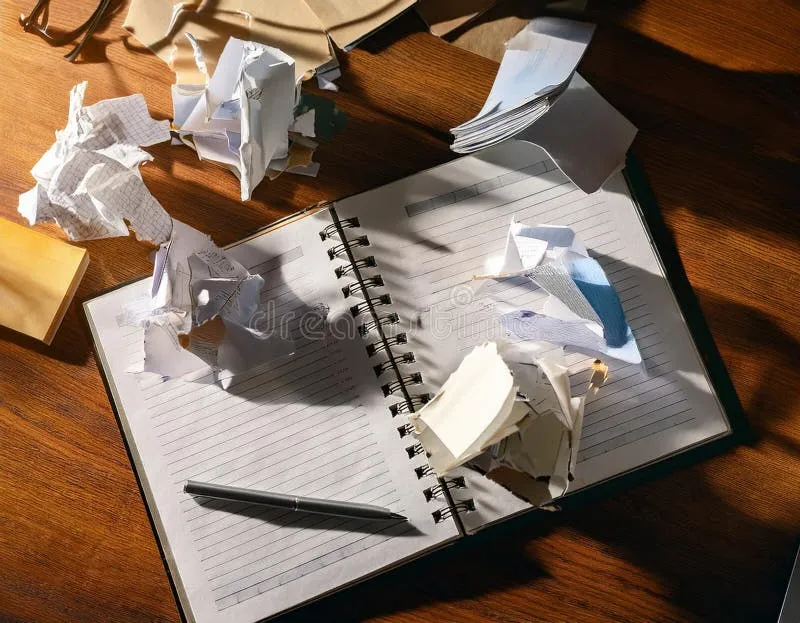
They arrive in manila envelopes, unmarked and unstamped. Sometimes tucked behind loose baseboards in abandoned office buildings. Other times discovered in storage units whose rental histories show gaps—months or years where no payments were made, yet the contents remained undisturbed. The artifacts themselves share certain characteristics: water damage despite no apparent source of moisture, a persistent chemical odor that defies identification, and handwriting that grows increasingly erratic across sequential pages.
Dr. Sarah Chen's private archive now houses forty-seven such items, each catalogued with forensic precision. What emerges from her analysis is not merely a record of displacement, but a taxonomy of psychological deterioration occurring in spaces that should not exist.
 Photo: Dr. Sarah Chen, via www.myhealth.net.au
The Language of Isolation
The earliest entries follow predictable patterns. "Day 1" appears in nearly every recovered journal, often accompanied by sketches of fluorescent fixtures or rough floor plans. The handwriting remains steady, the tone optimistic. One note, found behind a false wall in a Detroit office complex, begins: "Definitely not where I was supposed to end up, but there has to be a way out. Just need to think systematically about this."
By what the writers label "Day 3" or "Day 4," systematic thinking gives way to stream-of-consciousness rambling. Sentences fragment. Words repeat. The fluorescent hum that permeates Level 0 begins appearing in the text itself—long strings of 'm' and 'n' sounds that serve no grammatical purpose but mirror the acoustic environment described by alleged returnees.
One particularly disturbing example, recovered from a cassette tape found in a defunct RadioShack, features twenty-seven minutes of a man reading the same shopping list aloud. His voice remains steady for the first twelve repetitions. By the fifteenth, he's weeping. The final repetitions dissolve into whispered fragments: "Milk... eggs... the humming never stops... bread... butter... they're watching from the corners..."
Navigation Attempts and Spatial Paradoxes
Nearly every recovered document contains attempts at mapmaking. These range from simple directional notes ("turned left at the stained ceiling tile, then right at the broken light") to elaborate grid systems that span multiple pages. What's remarkable is how these navigation attempts consistently break down.
Initial maps show confidence in spatial relationships. Corridors connect logically. Landmarks maintain consistent positions relative to each other. But as the entries progress, the maps become increasingly contradictory. The same landmark appears in multiple locations. Straight corridors curve back on themselves. One journal contains a map where the author has drawn arrows pointing in all directions from a single intersection, with the frustrated note: "This is impossible. The hallway can't connect to itself."
The most unsettling example comes from what appears to be a child's notebook, though the handwriting suggests adult authorship. Crayon drawings show the familiar yellow hallways, but the perspective shifts impossibly from page to page. Ceiling-mounted lights are sometimes above, sometimes below, sometimes embedded in walls that should be floors. The final drawing shows a figure standing in a room where all six surfaces are covered in the same stained carpet, with the caption: "I think I understand now. Up is a direction that doesn't exist here."
The Watchers in the Walls
References to entities appear in roughly sixty percent of recovered materials, though descriptions remain frustratingly vague. Most writers seem reluctant to describe what they've seen, instead focusing on sounds, smells, or the sensation of being observed. "Something in the walls," appears frequently, as does "the wet sound when I'm not moving."
One audio recording, found in a sealed plastic bag behind a loose air vent, captures what sounds like normal footsteps for the first eighteen minutes. Then a second set of footsteps joins—identical in rhythm and cadence, but with a subtle wetness to each impact. The recording continues for another hour, the two sets of steps maintaining perfect synchronization. Near the end, the original walker whispers: "I stopped moving five minutes ago."
The implications are clear to anyone familiar with Level 0 entity reports, though the recording itself provides no visual confirmation.
Temporal Inconsistencies
Perhaps the most disturbing aspect of the collection involves dates. Most writers attempt to track time, using everything from digital watches to hash marks on walls. But the chronologies don't align with external evidence. Carbon dating of paper and ink suggests some documents are decades old, despite references to smartphones and recent cultural events.
One note, found in a Chicago office building slated for demolition, bears yesterday's date. The handwriting is fresh, the ink still slightly damp. It reads: "If someone finds this, I've been here for what feels like months. My phone died on Day 12, but somehow I know it's March 15th, 2024. The humming is getting louder. I think it's trying to tell me something."
The note was discovered on March 13th, 2024.
Dr. Chen's analysis suggests three possibilities: temporal displacement, elaborate hoaxes, or something far worse—the idea that Level 0 exists slightly ahead of our timeline, that the people writing these notes are documenting events that haven't quite happened yet.
The implications of this third possibility keep her awake at night, particularly when she considers the note dated two days in the future that arrived in her mailbox this morning.