The Architecture of Nowhere
If you grew up in America between 1985 and 2005, you know the Backrooms before you ever heard the term. You've walked those corridors—not the infinite yellow maze of Level 0, but the prototypes that trained your nervous system to recognize when architecture turns hostile. The after-hours elementary school where your mother taught summer classes. The Sears department store in its final year, half the fluorescents burned out and merchandise spread thin across acres of beige carpet. The medical complex where you waited for appointments, all blonde wood and motivational posters, designed to feel welcoming but achieving something closer to sedation.
This is the landscape that raised us: spaces built for function, optimized for efficiency, stripped of any meaning beyond their immediate purpose. We learned to navigate environments that existed purely as containers for activity—retail, education, healthcare, commerce—without any acknowledgment that human beings might need more from their surroundings than mere utility.
The Backrooms didn't emerge from Japanese horror or European surrealism. It crawled out of American suburbia, from the specific way this country builds spaces that feel like they're waiting for something that never comes.
The Liminal Curriculum
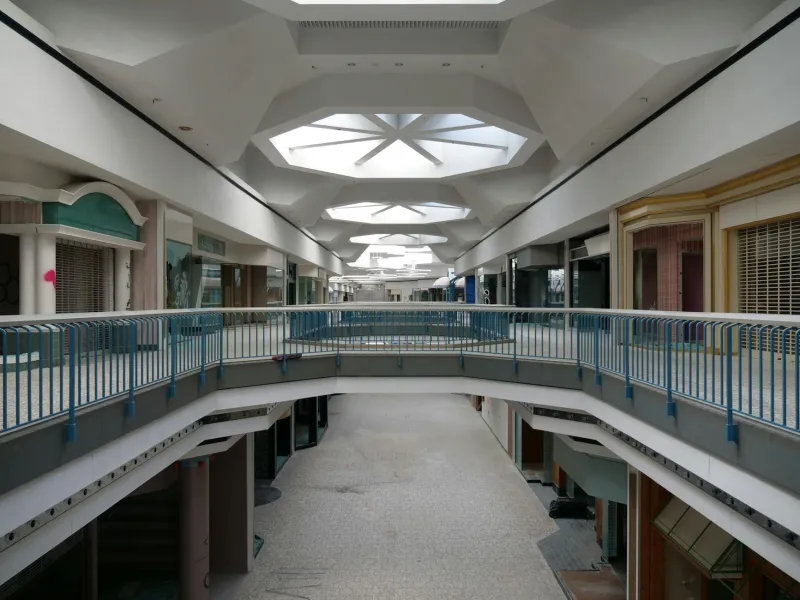
Consider the American shopping mall circa 1992. Designed as a community gathering space, it achieved something more like a laboratory for studying human behavior under fluorescent lights. The mall taught us that architecture could be simultaneously familiar and alienating, that spaces could feel both safe and wrong at the same time.
We learned this lesson early and repeatedly. The grocery store after 10 PM, when they dimmed half the lights and the Muzak echoed differently off empty aisles. The school building during parent-teacher conferences, when familiar hallways suddenly felt cavernous and strange. The office where your father worked, visited once during "bring your child to work day," all beige cubicles and humming machinery that seemed to serve no identifiable purpose.
These weren't traumatic experiences—they were formative ones. They taught us that the built environment could shift its emotional valence without any physical change. A space that felt normal at 3 PM could feel deeply wrong at 8 PM, not because anything had changed about the architecture itself, but because we began to notice what had always been there: the fundamental emptiness at the heart of purely functional design.
The American suburban landscape is built on a specific kind of architectural philosophy: spaces should serve their purpose efficiently and nothing more. Beauty, meaning, historical continuity—these are luxuries that interfere with the primary goal of moving people and products through space as quickly and cheaply as possible.
The Big Box Generation
We were the first generation to grow up entirely within this landscape. Previous generations had downtowns, neighborhoods with architectural character, public spaces designed for lingering rather than transit. We had Walmart, Home Depot, and Target—vast spaces that felt infinite when you were eight years old, designed to be navigated quickly but somehow always taking forever.
 Photo: Home Depot, via d3cnqzq0ivprch.cloudfront.net
The big-box store taught us specific lessons about space and movement. Entrances that funneled you past displays designed to catch your attention. Aisles wide enough for shopping carts but somehow always feeling crowded. Ceilings high enough to accommodate industrial shelving but low enough to feel oppressive. Lighting bright enough to eliminate shadows but harsh enough to make everything look slightly unreal.
Most importantly, these spaces taught us that architecture could be simultaneously vast and claustrophobic. The Target near my childhood home had roughly 180,000 square feet of floor space—larger than most city blocks—but the experience of moving through it felt constrained, directed, controlled. You were free to wander, but the wandering always led back to the checkout lanes.
This is the spatial logic of the Backrooms: infinite space that somehow feels like a trap.
The Office Park Aesthetic
While we were learning to navigate retail spaces, our parents were working in office parks—low-slung buildings surrounded by parking lots, designed to be completely interchangeable. The office park represents the purest expression of American architectural pragmatism: buildings that could house any business, in any suburb, serving any function that required people to sit at desks under fluorescent lights.
These buildings trained an entire generation of workers to accept architecture as purely functional background. Dropped ceilings, modular furniture, carpet tiles that could be replaced individually when stained—every design choice prioritized maintenance efficiency over human comfort or aesthetic pleasure.
The office park also taught us about architectural time—spaces that felt frozen in an eternal present, designed to be renovated incrementally without ever changing their fundamental character. The office building where your parent worked in 1995 looked essentially identical to the one where they worked in 2005, despite a decade of supposed technological progress.
This temporal stasis is central to the Backrooms experience. These spaces feel unstuck from time not because they're otherworldly, but because they're designed to resist the passage of time entirely. They're built to be maintained indefinitely without ever evolving, upgraded continuously without ever improving.
The Fluorescent Uncanny
The lighting is what ties it all together. Fluorescent tubes humming at 60 Hz, casting light that eliminates shadows but somehow makes everything look flat and lifeless. This is the lighting of institutional spaces—schools, hospitals, offices, stores—designed to provide maximum visibility at minimum cost.
We learned to associate this light with transitional spaces, places you passed through rather than places you inhabited. The DMV, the waiting room, the hallway between classes. Fluorescent lighting became the visual signature of spaces that served administrative functions, where human beings were processed rather than welcomed.
The Backrooms simply extends this logic to its natural conclusion: what if there was nothing but the transitional space? What if the hallway never led anywhere, if the waiting room was all there was to wait for?
Recognition and Resistance
The reason the Backrooms resonates so powerfully with Americans born into suburban sprawl isn't that it's an alien nightmare—it's that it's a familiar one. The yellow walls and buzzing lights of Level 0 aren't strange because they're otherworldly; they're strange because they're exactly the kind of space we've been taught to ignore, to pass through without noticing, to accept as the unremarkable background of daily life.
The horror of the Backrooms isn't that it's impossible—it's that it's all too possible. It's the logical endpoint of an architectural philosophy that treats human spaces as purely functional containers, optimized for efficiency and stripped of any acknowledgment that people might need beauty, meaning, or connection from their built environment.
We recognize the Backrooms because we've been living in its prototype our entire lives. The difference is that in the real world, we can still leave. We can go home to spaces that feel human, or find pockets of architectural meaning in older buildings that remember what it felt like to be designed for people rather than processes.
But what happens when there is no home to return to? What happens when the transitional space becomes the only space, when the hallway extends infinitely in all directions?
The Architecture of Anxiety
The Backrooms may be fictional, but the architectural anxiety it represents is entirely real. It's the creeping suspicion that the spaces we've built to contain our lives are somehow wrong, that efficiency and function aren't enough to sustain human flourishing, that there's something fundamentally hostile about environments designed without any consideration for the psychological needs of the people who must inhabit them.
This anxiety has been building for decades, as American communities have been reorganized around the logic of the automobile and the big-box store, as public spaces have been privatized and optimized, as architecture has become increasingly standardized and interchangeable.
The Backrooms gives this anxiety a name and a face. It transforms the vague sense that something is wrong with our built environment into a specific nightmare: what if you could never leave? What if the mall, the office, the school hallway extended forever, with no exit and no destination?
For those of us who grew up in fluorescent-lit suburbia, this isn't a difficult nightmare to imagine. We've been rehearsing it our entire lives, every time we've found ourselves alone in a big-box store after closing time, every time we've walked down an empty school corridor during summer break, every time we've realized that the architecture surrounding us was designed by people who never considered whether human beings might need something more than mere shelter from the weather.
The Backrooms is American horror because it's built from American materials: the specific dread of recognizing that the landscape of your childhood was designed to be navigated quickly and forgotten immediately, that the spaces that shaped your understanding of architecture were themselves shaped by a philosophy that considered human comfort and meaning to be unnecessary luxuries.
In the end, perhaps that's why the Backrooms feels so familiar to so many of us. We've been preparing for it our entire lives, wandering through spaces that were always already a little bit wrong, a little bit empty, a little bit too bright and too quiet and too much like a place where no one was ever meant to stay.